Happy Present Meet
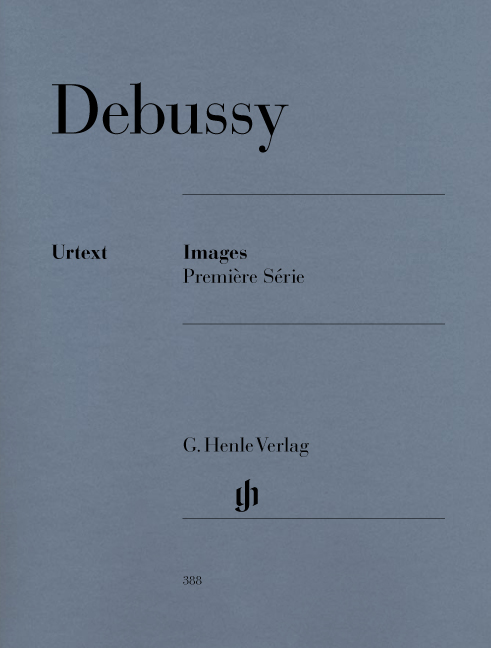
Debussy Images Vol.1 for Piano Solo
드뷔시 영상 1집 피아노 독주(솔로)
악기 구성
Piano Solo 피아노 독주(솔로)
Ernst-Gunter Heinemann (Editor) 에른스트귄터 하이네만
Hans-Martin Theopold (Fingering Piano) 한스마르틴 테오폴트
François Lesure (Preface) 프랑수아 르쥐르
Urtext Edition, paperbound
Pages 35 (IV+31)
Content
Hommage à Rameau 라모를 기리며
7 difficult
Mouvement 움직임
8 difficult
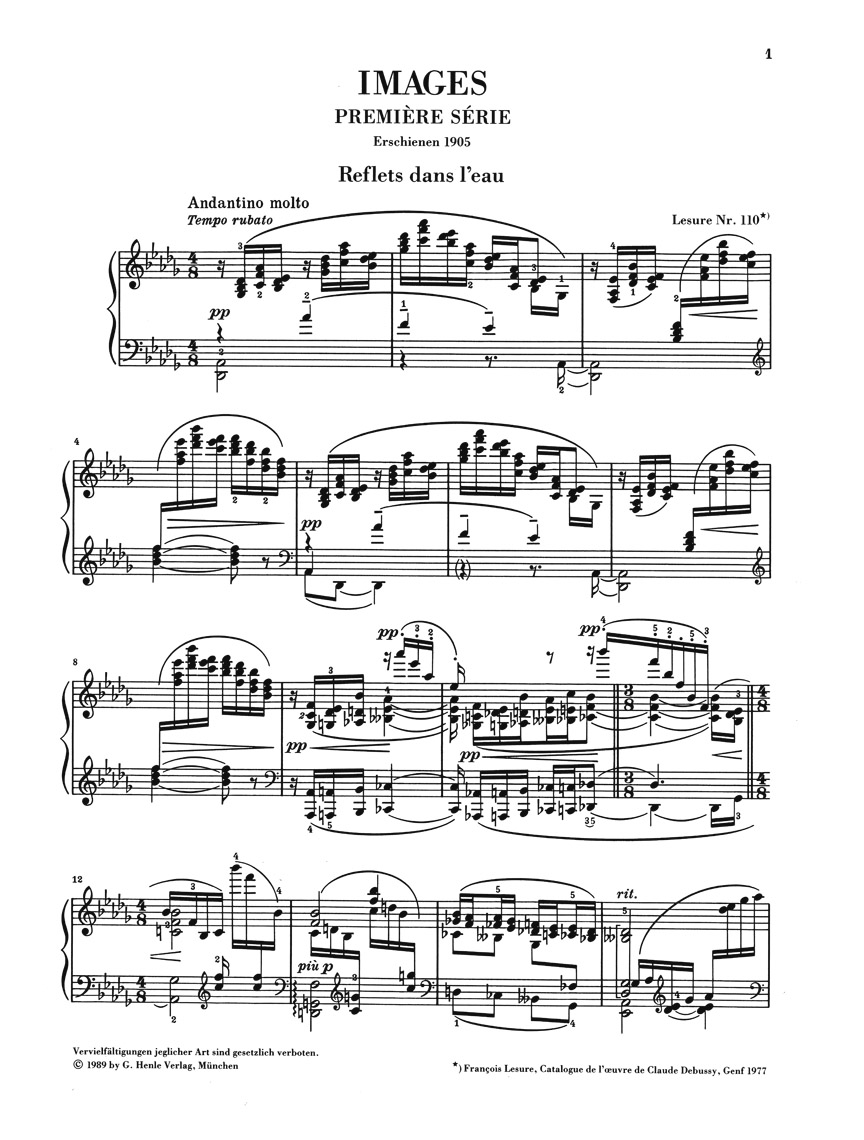
Reflets dans l'eau 물의 반영
8 difficult
“Have you played the Images ...? Without undue vanity, I believe that these three pieces can hold their own and will assume a place in the piano literature ... to the left of Schumann or to the right of Chopin ... as you like it.” Thus wrote Debussy in a letter to his publisher and friend Jacques Durand in 1905. Debussy’s prophecy was to become true. The pieces have become a fixed part of piano repertoire. Incidentally: for the slow movement Hommage à Rameau Debussy, an innovator who was still aware of tradition, was inspired by a performance of Castor et Pollux in 1903.
「『영상』을 쳐 보셨습니까…? 지나친 허영심 없이 말하자면, 이 세 곡은 제 몫을 해낼 것이고 피아노 문헌 속에서 자리를 차지할 것이라 믿습니다… 슈만의 왼쪽이나 쇼팽의 오른쪽에… 마음에 드시는 대로.」 드뷔시는 1905년 출판인이자 친구인 자크 뒤랑에게 보낸 편지에 이렇게 썼습니다. 드뷔시의 예언은 현실이 되었습니다. 이 곡들은 피아노 레퍼토리의 확고한 일부가 되었습니다. 덧붙이자면, 전통을 잊지 않았던 혁신가 드뷔시는 느린 곡 「라모 찬가(Hommage à Rameau)」를 쓸 때 1903년 「카스토르와 폴뤽스(Castor et Pollux)」 공연에서 영감을 받았습니다.
작곡가 Debussy, Achille Claude (1862-1918)
에디터 Heinemann, Ernst-Gunter