
Happy Present Meet
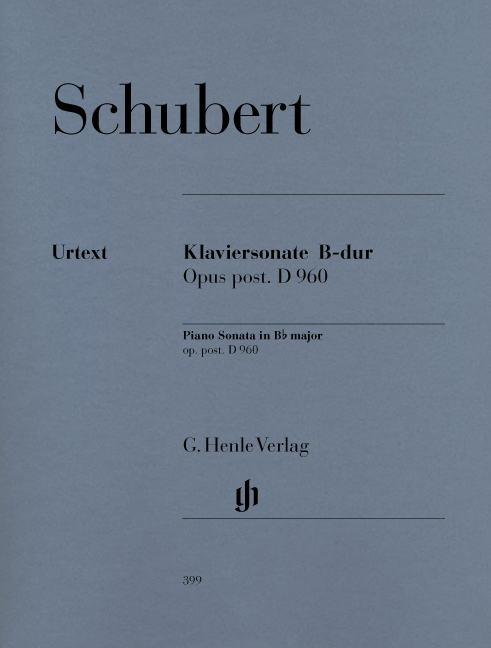
Schubert Piano Sonata in Bb major D 960 for Piano Solo
슈베르트 피아노 소나타 Bb장조 Op. post. D 960 피아노 독주(솔로)
악기 구성
Piano Solo 피아노 독주(솔로)
Paul Mies (Editor) 파울 미스
Hans-Martin Theopold (Fingering Piano) 한스마르틴 테오폴트
Urtext Edition, paperbound
Pages 36 (I+35)
Content
Piano Sonata Bb major op. post. D 960 피아노 소나타 Bb장조
7 difficult
In 1828, the last year of his life, Franz Schubert composed three sonatas for piano which are generally described as the culmination of his lifelong occupation with the piano sonata genre. Schubert’s role as successor to classical-era composers is clearly evident in them, while at the same time his very own, deeply personal tone resounds here. Our carefully revised edition of this frequently performed B flat major Sonata is based on the autograph and first edition. Once again, Schubert here seems to have gathered up all his powers of introspection and tranquillity. Above all, the calm theme of the first movement captivates through its dreamlike expression. While it does not pose technical-virtuosic problems for the player, itis highly demanding in terms of luminosity of tone and of subtlety of nuance.
생애 마지막 해인 1828년에 프란츠 슈베르트는 피아노 소나타 세 곡을 작곡했으며, 이 곡들은 일반적으로 그가 평생 몰두한 피아노 소나타 장르의 정점으로 평가됩니다. 이 곡들에서는 고전주의 작곡가들의 후계자로서 슈베르트의 역할이 분명히 드러나는 동시에, 그만의 깊고 개인적인 음색이 울려 퍼집니다. 자주 연주되는 이 Bb장조 소나타를 꼼꼼히 개정한 헨레 판은 자필 악보와 초판을 바탕으로 합니다. 이 곡에서 슈베르트는 다시 한번 내면 성찰과 고요함의 힘을 모두 끌어모은 듯합니다. 무엇보다 첫 악장의 고요한 주제는 꿈결 같은 표현으로 마음을 사로잡습니다. 연주자에게 기교적·명인기적 문제를 안기지는 않지만, 음색의 광채와 뉘앙스의 섬세함 면에서는 매우 높은 수준을 요구합니다.
작곡가 Schubert, Franz (1797-1828)
에디터 Mies, Paul
Schubert Piano Sonata in G major Op.78 D 894 for Piano Solo
Meet George Gershwin At The Keyboard for Piano Solo
Tchaikovsky The Seasons Op.37a for Piano Solo
Schubert Piano Sonata in A major D 959 for Piano Solo
Faure Pavane Op.50 for Piano Solo
Faure 3 Romances sans Paroles (3 Songs Without Words) Op.17 for Piano Solo