Happy Present Meet
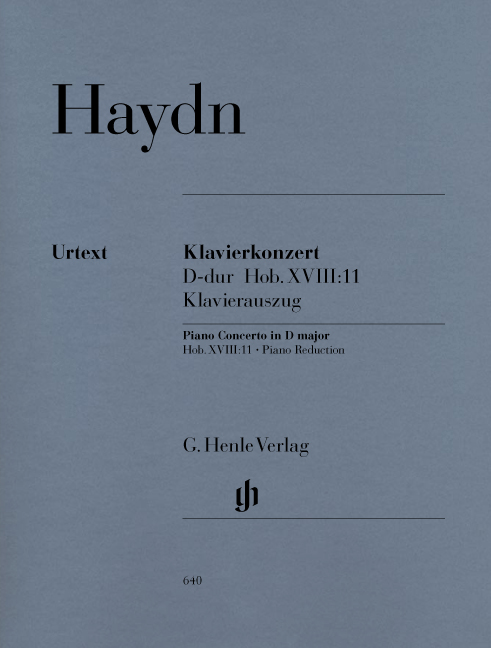
Haydn Piano Concerto (Harpsichord) in D major Hob.XVIII:11 for 2 Pianos 4 Hands
하이든 피아노(하프시코드) 협주곡 D장조 Hob.XVIII:11 (2 피아노 4 핸즈, 두 대의 피아노)
악기 구성
2 Pianos 4 Hands 2 피아노 4 핸즈(두 대의 피아노)
Bettina Wackernagel (Editor) 베티나 바커나겔
Horst Walter (Editor) 호르스트 발터
Sonja Gerlach (Piano reduction) 조냐 게를라흐
Klaus Schilde (Fingering Piano) 클라우스 쉴데
Piano reduction, Urtext Edition, paperbound
two copies needed for performance
Concertos for Piano (Harpsichord) and Orchestra F major and G major see Piano Quintet or Orchestra
Pages 50 (IV+46)
Content
Piano Concerto (Harpsichord) D major Hob.XVIII:11 피아노 협주곡 (하프시코드) D장조
4 medium
In contrast to Mozart, Haydn was not a keyboard virtuoso. He certainly conducted his orchestral works from the harpsichord, and also performed his own piano sonatas, but any ambition to be a concertizing pianist was foreign to his nature. Thus “only” three piano concertos by Haydn have come down to us. Owing to its catchy, fresh melodies, its harmonic nuances and its clear classical concerto architecture, the Concerto for piano and orchestra in D Major Hob. XVIII:11 is the most frequently played. In spite of its high profile we know neither the occasion for which it was written nor the year of its composition. The preface to our piano reduction edition deals with these questions in detail. The edition is based on the musical text of the Haydn Complete Edition, which is likewise published G. Henle Publishers.
모차르트와 달리 하이든은 건반 비르투오소가 아니었습니다. 그는 분명 하프시코드 앞에서 자신의 관현악 작품을 지휘했고 자신의 피아노 소나타도 연주했지만, 협연하는 피아니스트가 되려는 야심은 그의 성향과 거리가 멀었습니다. 그래서 하이든의 피아노 협주곡은 「단」 세 곡만 전해집니다. 귀에 쏙 들어오는 신선한 선율, 화성의 뉘앙스, 명료한 고전주의 협주곡 구조 덕분에 피아노와 관현악을 위한 협주곡 D장조 Hob.XVIII:11이 가장 자주 연주됩니다. 이처럼 널리 알려져 있는데도 이 곡이 어떤 계기로 쓰였는지, 몇 년에 작곡되었는지는 알려져 있지 않습니다. 헨레의 피아노 리덕션판 서문은 이 문제들을 상세히 다룹니다. 이 판은 역시 헨레에서 출간하는 하이든 전집의 악보 본문을 바탕으로 합니다.
작곡가 Haydn, Joseph (1732-1809)
에디터 Wackernagel, Bettina
Walter, Horst