Happy Present Meet

Liszt 2 Ballads for Piano Solo
리스트 2개의 발라드 피아노 독주(솔로)
악기 구성
Piano Solo 피아노 독주(솔로)
Ernst-Gunter Heinemann (Editor) 에른스트귄터 하이네만
Rena Charnin Mueller (Editor) 리나 차닌 뮬러
Andreas Groethuysen (Fingering Piano) 안드레아스 그로에투이젠
Urtext Edition, paperbound
Pages 52 (VI+46)
Content
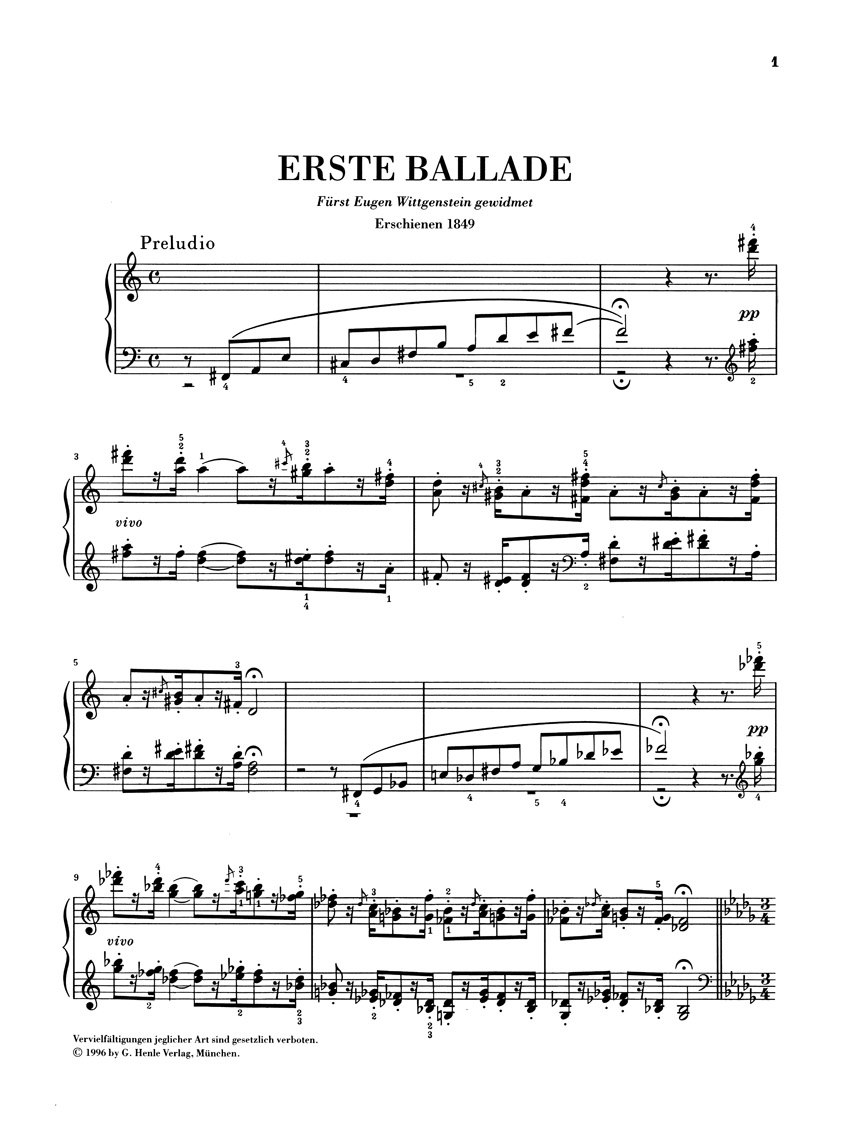
Ballad I (No.1) (1849) Db major 발라드 1번 (1849) Db장조
8 difficult
Ballad II (No.2) (1854) b minor 발라드 2번 (1854) b단조
8 difficult
Liszt wrote his two Ballades in 1845–49 and 1853 during a time of personal turmoil. The successful virtuoso increasingly saw himself as a composer who strove after formal clarity, as shown by the B minor sonata that was also composed in 1853. When Liszt began work on the first Ballade, he had just separated from his mistress of many years, Marie Comtesse d’Agoult. He called the first sketches for the work Dernières Illusions. A better-known work is the second Ballade in B minor, with whose ending he struggled (the two fortissimo endings in Liszt’s autograph have been published for the first time in the appendix to our edition).
리스트는 두 곡의 발라드를 개인적으로 혼란스러운 시기였던 1845–49년과 1853년에 썼습니다. 성공한 비르투오소였던 그는 점점 자신을 형식적 명료함을 추구하는 작곡가로 여기게 되었으며, 이는 역시 1853년에 작곡된 b단조 소나타에서도 드러납니다. 리스트가 첫 번째 발라드 작업을 시작했을 때, 그는 오랜 연인 마리 다구 백작부인과 막 헤어진 참이었습니다. 그는 이 작품의 첫 스케치에 「마지막 환상(Dernières Illusions)」이라는 이름을 붙였습니다. 더 잘 알려진 작품은 b단조의 두 번째 발라드로, 리스트는 그 결말을 두고 고심했습니다(리스트 자필 악보에 있는 두 가지 포르티시모 결말은 헨레 판 부록에 처음으로 출판되었습니다).
작곡가 Liszt, Franz (1811-1886)
에디터 Heinemann, Ernst-Gunter
Mueller, Rena Charnin