Happy Present Meet
Matosinhos 15 Low Horn Etudes
DESCRIPTION
15 LOW HORN ETUDES
Mr Matosinhos wrote 15 Low Horn Etudes as an extension of his series of fun etudes, this time written for low horn. Continued in the frivolous and fancy free style as the jazz etudes, these etudes concentrate on the difficulties of the low horn register, a register that is often ignored both by students as well as publishers!
Mr Matosinhos는 그의 재미있는 연습곡 시리즈의 연장선으로 15개의 Low Horn 연습곡을 썼는데, 이번에는 Low Horn을 위해 작곡되었습니다. 재즈 연습곡처럼 경박하고 화려한 자유로운 스타일로 계속되는 이 연습곡은 학생과 출판사 모두가 종종 무시하는 음역인 저음역의 어려움에 집중합니다
DEDICATION
This book is dedicated to Sarah Willis for all her work as a low horn player and for being such a big inspiration for all hornists.
This is the third etude book for horn written by me, which was fun to do, but also a personal challenge as during the whole process. Ultimately I fought against my worst nightmare. By way of explanation, I find the low horn the most difficult range to master.
There are many high horn etude books but very few for low horn, which is just as interesting and really deserves to be promoted more. Thus most times it seems to me that the great majority of students is simply obsessed with high horn playing and tend to forget to practice the middle and low register, which I find very unfair as they are amazingly appealing. Furthermore, not all books available for low horn are exactly fun to play, which has proved to be another hardship.
이 책은 로우 호른 연주자로서 그녀의 모든 활동과 모든 호른 연주자들에게 큰 영감을 준 사라 윌리스에게 헌정됩니다.
이 책은 제가 쓴 호른의 세 번째 에뛰드 책입니다. 이 책은 만드는 내내 즐거웠지만, 전체 과정에서 개인적인 도전이기도 했습니다. 결국 나는 최악의 악몽과 싸웠다. 설명하자면, 저는 로우 혼이 마스터하기 가장 어려운 범위라고 생각합니다.
하이혼 연습곡은 많지만 로우혼에 대한 책은 거의 없습니다. 이 책 역시 흥미롭고 더 많이 홍보할 가치가 있습니다. 따라서 대부분의 학생들은 단지 고음역과 저음역 연습을 잊어버리는 경향이 있는 것 같습니다. 나는 그것이 놀라울 정도로 매력적이기 때문에 매우 불공평하다고 생각합니다. 더욱이, 로우 혼용으로 제공되는 모든 책이 플레이하기에 정확히 재미있는 것은 아니며 이는 또 다른 어려움임이 입증되었습니다.
PURPOSE
The aim of this book is to practice the horn’s low register at different difficulty levels. Therefore these etudes use different styles with a strong rhythmic component, some extended techniques and, of course, a lot of fun!
목적
이 책의 목적은 다양한 난이도에서 호른의 저음역을 연습하는 것입니다. 따라서 이 연습곡은 강력한 리듬 구성 요소, 일부 확장된 기술 및 많은 재미를 갖춘 다양한 스타일을 사용합니다!
ETUDE NO.1
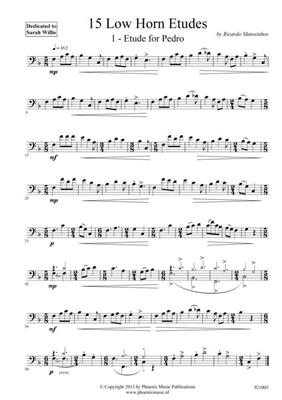
In the first place, Etude No. 1 is written entirely in F clef. Consequently tt has a range of 2 octaves without going further than the middle f. It is based on an ear catching F major melody, though the meter is always changing.
에뛰드 NO.1
애초에 에뛰드 1번은 전부 F음자리표로 쓰여져 있어요. 결과적으로 tt는 중간 f를 넘지 않고 2옥타브의 범위를 갖습니다. 미터는 항상 바뀌지만 귀를 사로잡는 F장조 멜로디를 기반으로 합니다.
ETUDE NO.2
Following is Etude No. 2, which is composed as an F Blues. It has a range of approximately 3 octaves. All through the etude there are many horn chords, flutter tongues and several jumps as well. Each harmony repetition proposes new and fun challenges to the player. There are no printed dynamics, which allows the player to choose his own.
에뛰드 NO.2
다음은 F Blues로 구성된 Etude No.2입니다. 대략 3옥타브 정도의 음역을 가지고 있습니다. 에튀드 전반에 걸쳐 많은 혼 코드, 펄럭이는 혀, 여러 번의 점프도 있습니다. 각 하모니 반복은 플레이어에게 새롭고 재미있는 도전을 제안합니다. 플레이어가 직접 선택할 수 있는 인쇄된 역학이 없습니다.
ETUDE NO.3
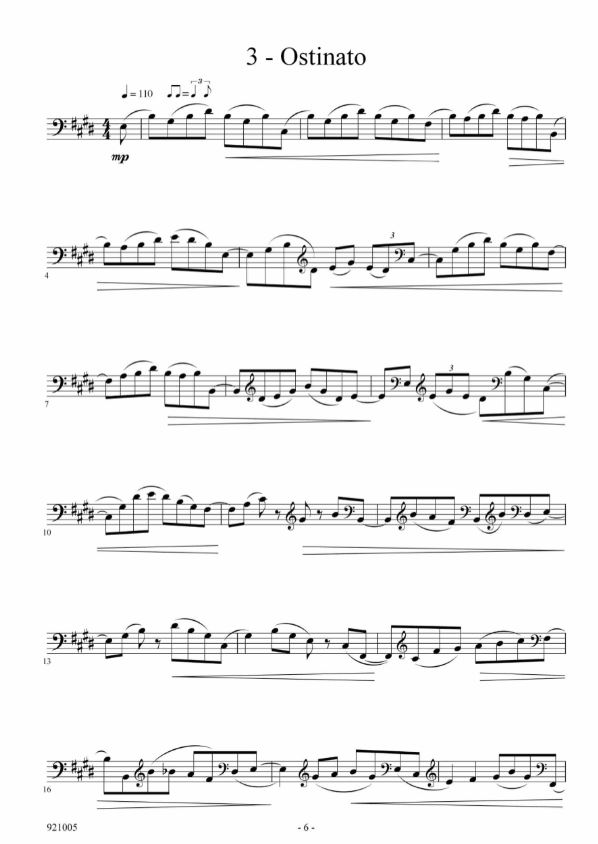
is based on a 4 bar ostinato. If this Etude is played entirely on a Bb horn, only the third and sometimes the first finger will be used. Several difficulties occur as a result of constant jumps that should be played gently without cutting the melodic lines.
에뛰드 NO.3
4마디 오스티나토를 기반으로 합니다. 이 연습곡 전체를 Bb 호른으로 연주하는 경우 세 번째 손가락, 때로는 첫 번째 손가락만 사용됩니다. 멜로디 라인을 자르지 않고 부드럽게 연주해야 하는 지속적인 점프로 인해 몇 가지 어려움이 발생합니다.
ETUDE NO.4
is mostly written on minor harmonic scales and inverted arpeggios, again there are no printed dynamics leaving these to the discretion of the performer. When there are constant 16th notes, the performer should breathe as necessary, making a small ritardando but without chopping up the phrases.
에뛰드 No.4
대부분 마이너 하모닉 스케일과 반전된 아르페지오로 작성되었으며, 연주자의 재량에 맡긴 다이내믹스가 인쇄되어 있지 않습니다. 16분 음표가 일정할 때 연주자는 필요에 따라 호흡해야 하며, 프레이즈를 자르지 않고 작은 리타르단도를 만들어야 합니다.
ETUDE NO.5
is built on a minor pentatonic and a blues scales. If played on a Bb horn, mainly the 3rd finger will be used.
에뛰드 NO.5
마이너 펜타토닉과 블루스 스케일로 만들어졌습니다. Bb 호른으로 연주할 경우 주로 3번째 손가락이 사용됩니다.
ETUDE NO.6
is composed using the constant alternation of different whole tone scales and augmented arpeggios.
에뛰드 NO.6
다양한 전체 톤 스케일과 증가된 아르페지오를 지속적으로 교대로 사용하여 구성됩니다.
ETUDE NO.7
is written in C minor, this etude is filled with syncopations, as traditionally used in Brazilian music. In the end, the half valve effect intends to imitate the “cuíca” (a traditional brazilian music instrument).
에뛰드 NO.7
C단조로 작곡된 이 연습곡은 브라질 음악에서 전통적으로 사용되는 당김음으로 가득 차 있습니다. 결국 하프 밸브 효과는 '쿠이카'(브라질 전통 악기)를 모방하려는 의도다.
ETUDE NO.8
is built as a Blues in G, with expressive jumps, lip bending and different glissandi. It should be played introspectively with a little rubato but a clear rhythm.
에뛰드 NO.8
표현력이 풍부한 점프, 입술 굽힘 및 다양한 글리산디를 갖춘 G의 블루스로 제작되었습니다. 약간의 루바토를 사용하되 명확한 리듬으로 성찰적으로 연주해야 합니다.
ETUDE NO.9
is starting with a slow introduction on hornchords, it is followed by a faster section working on jumps. In the end the “ploc” sign refers to the intended sound. The player should remove the first valve slide without pressing the valves.
에뛰드 NO.9
혼코드에 대한 느린 소개로 시작하여 점프에 대한 더 빠른 섹션이 이어집니다. 결국 "ploc" 기호는 의도한 사운드를 나타냅니다. 플레이어는 밸브를 누르지 않은 채 첫 번째 밸브 슬라이드를 제거해야 합니다.
ETUDE NO.10
is based on Augmented 4ths and minor 2nds. The introduction and finale should have a misterioso character, but always legato. The middle section should be energetic.
에뛰드 NO.10
증4도와 단2도를 기반으로 합니다. 도입부와 피날레는 미스터리한 성격을 띠어야 하지만 항상 레가토이어야 합니다. 중간 부분은 활력이 있어야 합니다.
ETUDE NO.11
is with a comic character, inspired by Caprice No.39 by Francisco Jose de Goya (1746-1828), where a donkey contemplates a family photo album and realizes his grandfather was already a donkey. The first half of the etude refers to his sad contemplation. However this feeling changes quickly into a comic and fast section, where the donkey accepts his fate and decides to carry on with his life. Finally the final glissandi intends to imitate the bray of the donkey.
에뛰드 NO.11
프란시스코 호세 데 고야(1746-1828)의 카프리스 No.39에서 영감을 받은 만화 캐릭터입니다. 당나귀는 가족 사진 앨범을 고민하다가 할아버지가 이미 당나귀였다는 사실을 깨닫게 됩니다. 에튀드의 전반부는 그의 슬픈 묵상을 담고 있다. 그러나 이 감정은 당나귀가 자신의 운명을 받아들이고 자신의 삶을 이어가기로 결정하는 코믹하고 빠른 부분으로 빠르게 변합니다. 마지막으로 마지막 글리산디는 당나귀의 울음소리를 흉내내려고 합니다.
ETUDE NO.12
is based on a melody used in several choral works by Johann Sebastian Bach (1685-1750). The etude is entirely written on horn chords and the indicated horn chords refer only to the played and the sung notes. Extra notes in some chords are to be expected.
에뛰드 NO.12
요한 세바스티안 바흐(1685-1750)의 여러 합창 작품에 사용된 멜로디를 기반으로 합니다. 에튀드는 전적으로 호른 코드로 작성되었으며 표시된 호른 코드는 연주된 음과 노래된 음만 나타냅니다. 일부 코드의 추가 음표가 예상됩니다.
ETUDE NO.13
is with a comic character. It intends to illustrate what someone feels when a stubborn sneeze insists on not happening. There are many off beat notes at the end of the phrases and these are intended to illustrate this feeling. After several attempts and frustrations illustrated by furious crescendi, the sneeze finally happens in the last bar.
에뛰드 NO.13
만화 캐릭터와 함께 있습니다. 이는 완고한 재채기가 일어나지 않을 때 누군가가 느끼는 감정을 설명하려는 의도입니다. 프레이즈 끝에는 비트가 다른 음표가 많이 있으며 이는 이러한 느낌을 설명하기 위한 것입니다. 격렬한 크레센디로 표현되는 여러 번의 시도와 좌절 끝에 마침내 마지막 마디에서 재채기가 발생합니다.
ETUDE NO.14
is based on D major and D blues scales, with a cantabile and leggiero character. The meters are changed by different syncopations, but these should always be played with an easy feeling.
에뛰드 NO.14
D 메이저와 D 블루스 스케일을 기반으로 하며 칸타빌레와 레지에로 특성이 있습니다. 미터는 다양한 당김음에 따라 변경되지만 항상 쉬운 느낌으로 연주해야 합니다.
ETUDE NO.15
is built on the mixolydian mode, based on major arpeggios separated by one tone and their inversions. Some sections include jumps and sometimes contain a few horn chords. It is very amusing to play.\n\nI hope that you can learn much from 15 Low Horn Etudes, but not less important is that you have fun with them!
에뛰드 NO.15
하나의 톤으로 분리된 주요 아르페지오와 그 반전을 기반으로 하는 믹솔리디안 모드를 기반으로 제작되었습니다. 일부 섹션에는 점프가 포함되어 있으며 때로는 몇 개의 혼 코드가 포함되어 있습니다. 연주하는 것은 매우 재미있습니다.\n\n저는 여러분이 15개의 로우 혼 연습곡에서 많은 것을 배울 수 있기를 바라지만, 그만큼 중요한 것은 여러분이 이 연습을 즐겁게 한다는 것입니다!
작곡가 Matosinhos, Ricardo