
Happy Present Meet
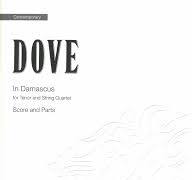
Dove, Jonathan In Damascus for Tenor and String Quartets (Full Score and Parts)
Instrumentation: String Quartet (Violin I, Violin II, Viola, Cello), Tenor
Genres: 20th Century
Duration 00:30:00
I have only visited Damascus once, twenty years ago, on the way to Palmyra. I had a purpose (I was writing music for a play about Palmyra’s Queen Zenobia) but essentially I was a tourist. Like any visitor, I was thrilled to step out of the noisy modern city into the magical ancient world of the walled Old City, its vibrant souk leading to the magnificent mosque, and a labyrinth of winding, narrow streets filled with the smell of unleavened bread.
In Palmyra, I was met with extraordinary kindness everywhere. On one occasion, a little Bedouin boy noticed that I was risking sunstroke wandering bare-headed among the spectacular ruins: he showed me how to tie a turban, then took me to have tea with his family in their tent.
Since then, I have watched helplessly as these places of wonder have been devastated and their inhabitants scattered and killed. When the Sacconi Quartet suggested that I might choose a Syrian poet for our collaboration, I welcomed the idea.
I searched for a long time to find a contemporary poet whose work might gain from any music I could imagine. I felt it was important to find first-hand accounts of the Syrian experience – but, of course, I was always reading them in translation. In an anthology called Syria Speaks, I was astonished to read something that looked like prose, but was full of poetry. It was Anne-Marie McManus’s fine translation of Ali Safar’s A Black Cloud in a Leaden White Sky – an eloquent, thoughtful, contained yet vivid account of life in a war-torn country, all the more moving for its restraint.
In setting these words, I have not attempted to imitate Syrian music. However, there is what might be called a linguistic accommodation in my choice of scale, or mode. Several movements are in a mode that I first discovered while writing a cantata commemorating the First World War: it has a tuning that I associate with war, its violence and desolation. This eight-note mode is similar to scales found in Syrian music. I did not choose it in the abstract: it emerged from the harmonies I was exploring in the earlier work, and emerged again as I was looking for the right musical colours to set Ali Safar’s words. In this work, its Arabic aspect is more prominent. - Jonathan Dove
저는 20년 전 팔미라로 가는 길에 다마스쿠스에 딱 한 번 들렀습니다. 목적이 있긴 했지만(팔미라의 제노비아 여왕에 관한 연극 음악을 작곡하고 있었죠), 사실상 관광객이나 다름없었습니다. 여느 관광객처럼 시끄러운 현대 도시를 벗어나 성벽으로 둘러싸인 고대 도시, 활기 넘치는 시장, 웅장한 모스크, 그리고 누룩 없는 빵 냄새로 가득한 미로 같은 좁은 골목길에 들어섰을 때, 저는 마치 마법에 걸린 듯한 기분이었습니다.
팔미라에서는 가는 곳마다 놀라운 친절을 경험했습니다. 한번은 어린 베두인 소년이 제가 햇볕에 타 죽을 뻔한 것을 보고 터번 매는 법을 가르쳐준 후, 자기 가족과 함께 텐트에서 차를 마시도록 초대해 주었습니다.
그 이후로 저는 이 경이로운 유적지가 파괴되고 주민들이 뿔뿔이 흩어져 죽어가는 모습을 속수무책으로 지켜봐야 했습니다. 사코니 콰르텟이 협업을 위해 시리아 시인을 선정해 보자고 제안했을 때, 저는 흔쾌히 승낙했습니다.
저는 오랫동안 제가 상상하는 어떤 음악과도 잘 어울릴 만한 현대 시인을 찾아 헤맸습니다. 시리아 사람들의 생생한 경험을 담은 시인을 찾는 것이 중요하다고 생각했지만, 늘 번역본으로만 접하고 있었습니다. 그러던 중, 『시리아가 말한다』라는 제목의 시선집에서 산문처럼 보이지만 시적인 표현으로 가득 찬 작품을 발견하고 깜짝 놀랐습니다. 앤 마리 맥매너스가 훌륭하게 번역한 알리 사파르의 시, 「납빛 흰 하늘 속의 검은 구름」이었습니다. 전쟁으로 피폐해진 나라의 삶을 유려하고 사려 깊으면서도 절제된 생생함으로 그려낸 이 시는 그 절제미 덕분에 더욱 깊은 감동을 선사했습니다.
이 시에 곡을 붙이면서 저는 시리아 음악을 모방하려 한 것은 아닙니다. 다만, 음계나 선법을 선택하는 과정에서 언어적인 조화가 이루어졌다고 할 수 있겠습니다. 몇몇 악장은 제가 제1차 세계 대전을 기념하는 칸타타를 작곡하면서 처음 발견한 선법으로 이루어져 있습니다. 이 선법은 전쟁, 그 폭력과 황폐함을 떠올리게 합니다. 8음으로 이루어진 이 선법은 시리아 음악에서 흔히 볼 수 있는 음계와 유사합니다. 제가 이 선법을 추상적으로 선택한 것은 아닙니다. 이전 작품에서 탐구했던 화성에서 자연스럽게 떠올랐고, 알리 사파르의 시에 어울리는 음악적 색채를 찾던 중에 다시금 발견하게 되었습니다. 이 작품에서는 아랍적인 색채가 더욱 두드러집니다. - 조너선 도브
작곡가 Dove, Jonathan