Happy Present Meet
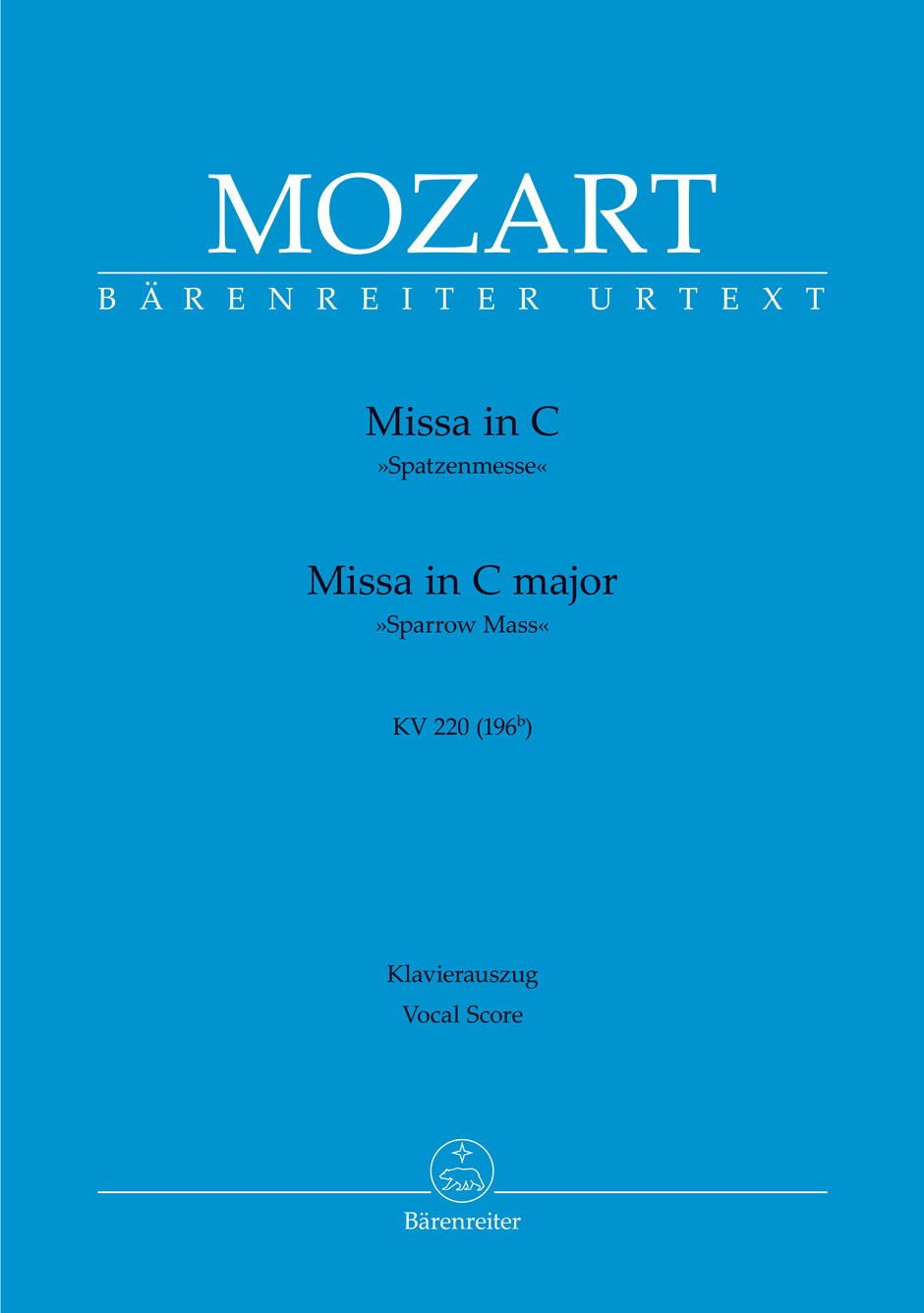
Mozart Missa in C major K.220 (196b) "Sparrow Mass" (Vocal Score)
SATB and Piano
Vocal score on the basis of the “New Mozart Edition”
Well-presented easy-to-play piano part
Full score and orchestral parts continue to be available under BA05343
Product format: Vocal Score, Urtext edition
Language of the work: Latin
Languages of the text: German, English
Prince Archbishop Hieronymus Count von Colloredo demanded a mixed form for the masses performed in Salzburg: a Missa brevis in terms of length but with the instrumentation of a Missa solemnis with timpani and trumpets. With the Missa in C major K. 220, Mozart presented a work around 1775 that met these requirements for the first time. The work was nicknamed “Spatzenmesse” (Sparrow Mass) because of a distinctive motif played by the violins in the Sanctus and Benedictus.
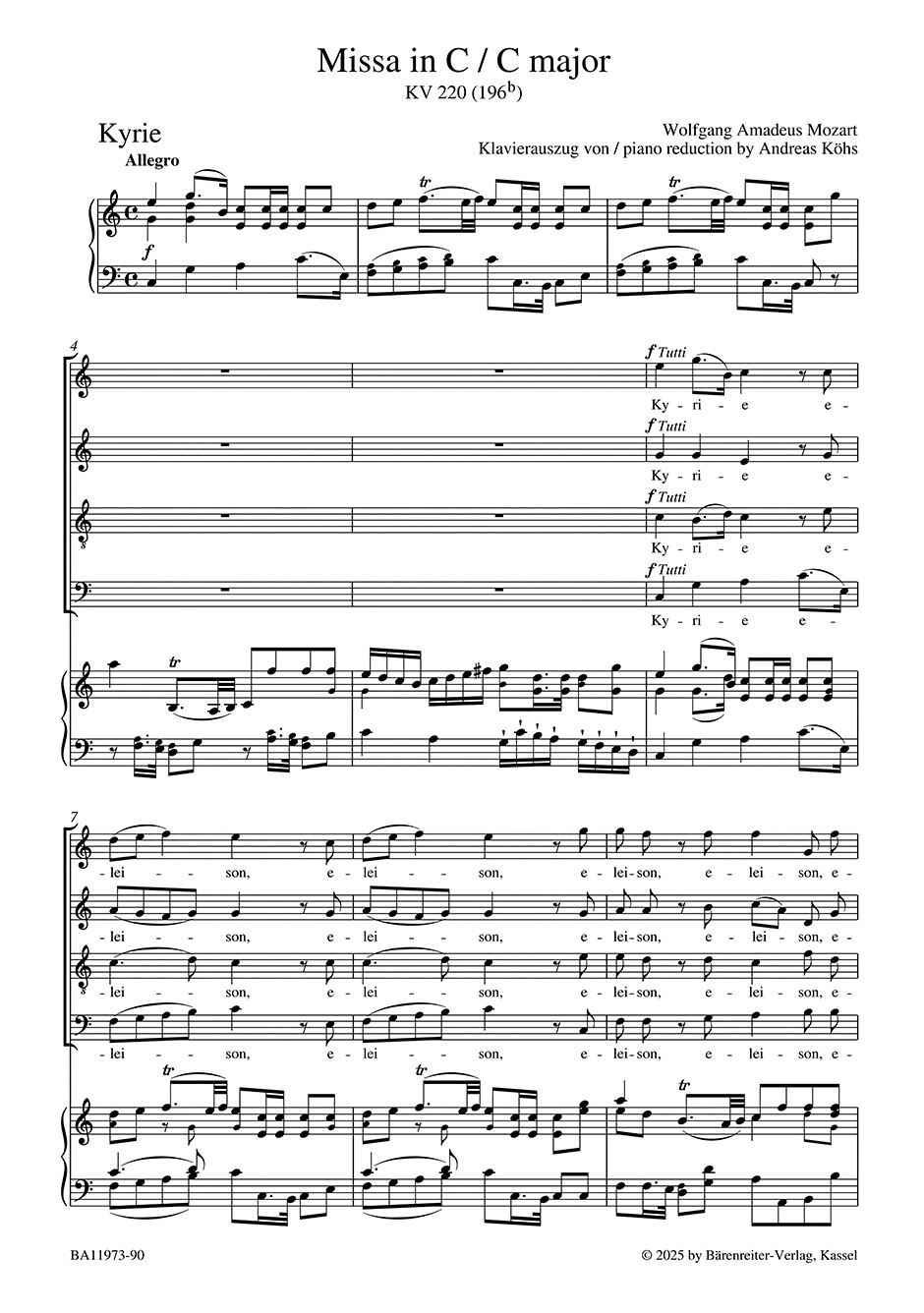
For the piano part, Andreas Köhs has provided an improved orchestral reduction that optimally transfers the instrumental parts to the piano and at the same time prioritizes playability. The vocal parts are based on the Urtext of the “New Mozart Edition”.
This vocal score is compatible with the previous edition (BA05343-90), so there is no problem if some choir members use the new edition and others still use the older one. The full score and orchestral parts will continue to be available under BA05343.
대주교 히에로니무스 폰 콜로레도 백작은 잘츠부르크에서 공연되는 미사곡에 혼합 형식을 요구했습니다. 즉, 길이는 짧은 미사(Missa brevis)이지만, 팀파니와 트럼펫이 연주되는 솔렘니스 미사(Missa solemnis)의 기악 편성을 요구했습니다. 모차르트는 1775년경 C 장조 미사곡 K. 220을 통해 이러한 요건을 처음으로 충족하는 작품을 발표했습니다. 이 작품은 상투스(Sanctus)와 베네딕투스(Benedictus)에서 바이올린이 연주하는 독특한 모티프 때문에 "스파첸메세(Spatzenmesse)"라는 별명이 붙었습니다.
피아노 파트의 경우, 안드레아스 쾨흐스는 기악 파트를 피아노로 최적으로 옮기는 동시에 연주성을 우선시하는 향상된 관현악 편곡을 적용했습니다. 성악 파트는 "신 모차르트 판본"의 원전(Urtext)을 기반으로 합니다.
이 성악 악보는 이전 버전(BA05343-90)과 호환되므로, 일부 합창단원은 새 버전을 사용하고 다른 단원은 이전 버전을 사용하더라도 문제가 없습니다. 전체 악보와 오케스트라 파트는 BA05343 버전에서 계속 이용할 수 있습니다.
Contents
Kyrie
Gloria
Credo
Sanctus
Benedictus
Agnus Dei
편곡자 Kohs, Andreas
작곡가 Mozart, Wolfgang Amadeus(1756-1791)
에디터 Senn, Walter