
Happy Present Meet

Debussy 12 Etudes Volumes 1 and 2 for Piano Solo
드뷔시 12개의 연습곡 - 피아노
Debussy Douze Etudes for Piano Solo
extrait du - excerpt from Série I Vol. 6
편집자: 클로드 엘페르 (Claude Helffer)
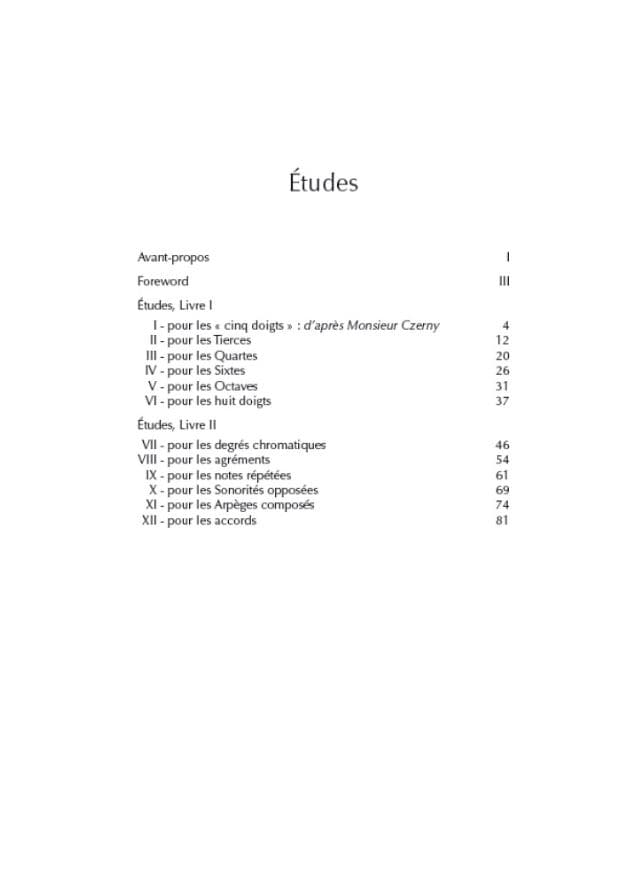
Contents
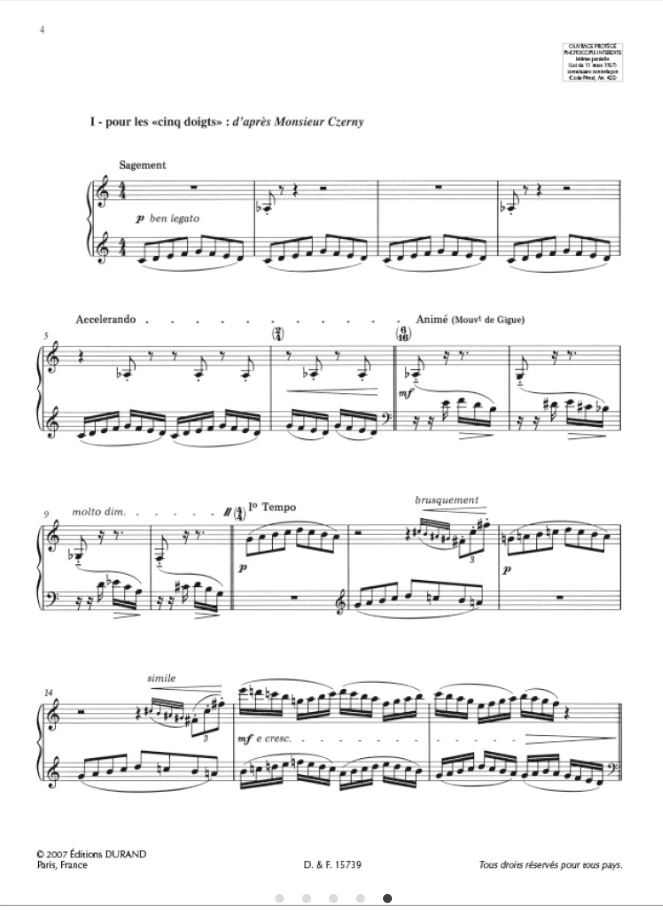
1. Pour les "Cinq doigts"
2. Pour les Tierces
3. Pour les Quartes
4. Pour les Sixtes
5. Pour les Octaves
6. Pour les Huit Doigts
7. Pour les degres chromatiques
8. Pour les agrements
9. Pour les notes repetees
10. Pour les sonorites opposees
11. Pour les Arpeges composes
12. Pour les accords
Series Durand Oeuvres Complètes de Claude Debussy
Publisher: Editions Durand
StylePeriodView Description Post 1901
Year of Publication 2007
Inventory: #HL 50564895
UPC: 884088216757
ISMN 9790044080717
Edition Number DD 15739
No. DD 01573900
Width: 9.0"
Length: 12.0"
Page Count: 88 Pages
These Etudes are deliberately presented without fingering for the following reasons: It is only logical that a single set of fingering will not suit all shapes and sizes of hand. Some modern editors try to get round this by piling different fingerings on top of one another, which only serves to add to the confusion… Music then startsto resemble some strange mathematics, producing an inexplicable phenomenon, whereby the fingers unaccountably multiply.The story of Mozart who, as a child prodigy on the harpsichord, finding himself unable to span all notes in a chord, fondly imagined he could hit one with the end of his nose, does not really resolve the problem; and in any case may owe more to theimagination of an over zealous editor than to reality.Our old Masters — I might mention here “our” admirable harpsichordists — never indicated any fingering, undoubtedly relying on the intelligence of their contemporaries. Similarly, it would be individious to doubt that of today’s virtuosi.In conclusion: the absence of fingering is an excellent exercise, removes the temptation to change the composer’s fingering merely for the sake of contradiction, and confirms the old saying anew, “Your own best servant is yourself.”Let us discover our own fingering.
이 연습곡들이 의도적으로 운지법 없이 제시된 데에는 다음과 같은 이유가 있습니다. 모든 손의 모양과 크기에 맞는 운지법이 존재할 수 없다는 것은 당연한 이치입니다. 일부 현대 편집자들은 이러한 문제를 해결하기 위해 여러 운지법을 겹쳐서 제시하는데, 이는 오히려 혼란만 가중시킬 뿐입니다. 그렇게 되면 음악은 마치 이상한 수학처럼 되어, 손가락이 설명할 수 없이 늘어나는 불가사의한 현상을 만들어냅니다. 어린 시절 하프시코드 신동이었던 모차르트가 화음의 모든 음을 짚을 수 없다는 것을 깨닫고 코끝으로 음을 칠 수 있다고 상상했다는 이야기는 이 문제를 해결해주지 못하며, 설령 그렇다 하더라도 지나치게 열성적인 편집자의 상상력에 더 가까울지도 모릅니다. 우리의 옛 거장들, 특히 훌륭한 하프시코드 연주자들은 운지법을 표시하지 않았는데, 이는 틀림없이 당시 연주자들의 지혜에 의존했기 때문일 것입니다. 마찬가지로, 오늘날의 거장들의 실력을 의심하는 것 또한 어리석은 일일 것이다. 결론적으로, 운지법이 없는 것은 훌륭한 연습이며, 단순히 모순을 만들기 위해 작곡가의 운지법을 바꾸고 싶은 유혹을 없애주고, "가장 좋은 하인은 바로 자신이다"라는 옛말을 다시금 확인시켜 준다. 이제 우리만의 운지법을 찾아보자.
편곡자 Helffer, Claude
작곡가 Debussy, Achille Claude (1862-1918)
Bartok Etudes Op.18 for Piano Solo
Schumann Piano Sonata No.2 in g minor Op.22 for Piano Solo
파데레프스키편 제2권 : 쇼팽 연습곡 (Paderewski : Chopin Etudes)
Beethoven Piano Variations Vol.2 for Piano Solo (Revised edition)
Chopin Preludes Op. 28, 45 for Piano Solo #07 - National Edition (ed. J. Ekier)
Chopin Etudes for Piano Solo #02 - National Edition (ed. J. Ekier)
Scriabin 12 Etudes Op.8 for Piano Solo
Mozart Complete Piano Sonatas Vol.1: No.1-9 (Urtext) for Piano Solo
Mozart Complete Piano Sonatas Vol.2: No.10-18 (Urtext) for Piano Solo