
Happy Present Meet
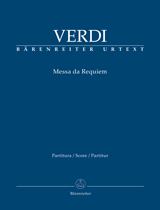
Verdi Messa da Requiem (Full Score)
베르디 레퀴엠 (진혼곡)
Soprano solo, Mezzo-soprano solo, Tenor solo, Bass solo, Mixed choir (SATB), Piccolo flute, Flute (2), Oboe (2), Clarinet (in B-flat) (2), Bassoon (4), Horn (4), Trumpet (4), Trp in lontananza (4), Trombone (3), Oficleide, Timpani, Concert drum, Violin (2), Viola, Violoncello, Double bass
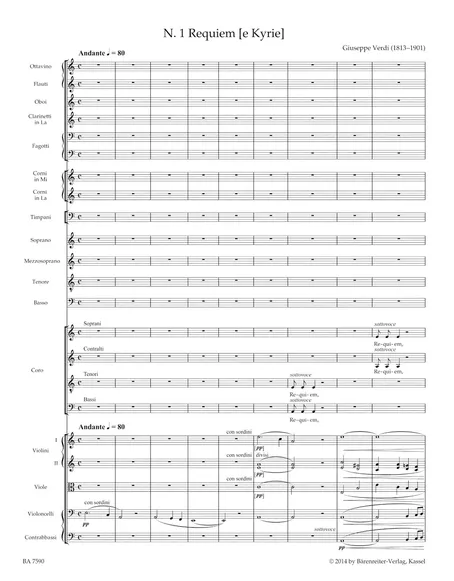
No.1 Requiem e Kyrie
No.2 Dies irae
No.3 Offertorio
No.4 Sanctus
No.5 Agnus Dei
No.6 Lux aeterna
No.7 Libera me, Domine
Appendix:
"Liber scriptus" first version
Genesis of the work:
1874
Facsimiles
Critical Commentary
- Verdi’s monumental work in a Bärenreiter Urtext edition
- Trilingual preface (Ital/Eng/Ger)
- Critical Commentary (Eng) in the score
In spite of the most enthusiastic reception at the work’s premiere, the famous pianist and conductor Hans von Bülow criticized Verdi’s Messa da Requiem as “an opera in ecclesiastical robes”. Nonetheless, or maybe precisely for this quality, the work has conquered concert podiums worldwide.
For this scholarly-critical edition, the editor has consulted no less than 16 sources, many more than were ever used for any other edition of the Requiem; some of these sources were never evaluated before and one source, a hand-written vocal score, particularly relevant to the evaluation of the “Liber scriptus”, was newly discovered.
As such, this edition offers new philological and editorial decisions regarding phrasing, articulation and dynamics and succeeds in presenting practical suggestions to solve musical problems and those concerning the interpretation of this famous work.
This edition comprises a concise Critical Commentary in the score. The most important editions published in the 19th century are compared with regard to musicological questions in the work. The genesis of some misunderstandings included in the 1913 and 1964 Ricordi editions is traced. The first version of the “Liber scriptus” for chorus is included in the appendix while the later version for mezzosoprano solo is to be found in the main part of the edition.
- 베렌라이터 원전(Urtext)에 담긴 베르디의 기념비적인 작품
- 3개 국어 서문(이탈리아어/영어/독일어)
- 악보에 대한 비평(영어)
초연 당시 엄청난 열광적인 반응에도 불구하고, 유명 피아니스트이자 지휘자인 한스 폰 뷜로는 베르디의 레퀴엠 메사 다 레퀴엠을 "성직자의 예복을 입은 오페라"라고 비판했습니다. 그럼에도 불구하고, 어쩌면 바로 이러한 특징 때문에 이 작품은 전 세계 콘서트 무대를 장악했습니다.
이 학술 비평판을 위해 편집자는 무려 16개의 자료를 참고했는데, 이는 다른 어떤 레퀴엠 판본보다 훨씬 많은 자료입니다. 이 자료들 중 일부는 이전에 평가된 적이 없었고, 특히 "리베르 스크립투스(Liber scriptus)" 평가에 특히 중요한 손으로 쓴 성악 악보가 새롭게 발견되었습니다.
따라서 이 판은 프레이징, 아티큘레이션, 그리고 다이내믹스에 관한 새로운 문헌학적, 편집적 결정을 제시하고, 이 유명한 작품의 해석과 관련된 음악적 문제들을 해결하기 위한 실질적인 제안을 제시합니다.
이 판은 악보에 간결한 비평 해설을 수록하고 있습니다. 19세기에 출판된 가장 중요한 판본들을 작품의 음악학적 질문들과 관련하여 비교 분석합니다. 1913년과 1964년 리코르디 판본에 포함된 몇 가지 오해의 근원을 추적합니다. 합창곡을 위한 "리베르 스크립투스"의 초기 버전은 부록에 수록되었으며, 메조소프라노 독주곡을 위한 후기 버전은 판의 본문에 수록되어 있습니다.
작곡가 Verdi, Giuseppe (1813-1901)
에디터 Uvietta, Marco
Schubert Symphony No.4 `Tragic` in C Minor D 417 for Full Score
Beethoven Symphony No.1 in C Major Op.21 (Full Score)
Beethoven Symphony No.2 in D major Op.36 (Full Score)
Beethoven Symphony No.8 in F major Op.93 for Full Score
Brahms Symphony No.1 in C minor Op.68 for Full Score
Brahms Symphony No.2 in D major Op.73 for Full Score
Shostakovich Symphony No.7 in C major Op.60 (Full Score)
Brahms Symphony No.3 in F major Op.90 (Full Score)
Orff Carmina Burana (Edition for voices, two pianos and percussion) (Full Score)