Happy Present Meet
Rameau Io RCT 45 for Vocal Score
Acte de Ballet
Fragmentary work completed with original music by Rameau
- Based on the score of “Opera Omnia Rameau”, Volume V/1
- Particularly suitable for academies and conservatories as few soloists are required and the few choral movements can be sung by soloists
Avertissement
Composer / Author:
Soury, Thomas
Introduction
Table de lo
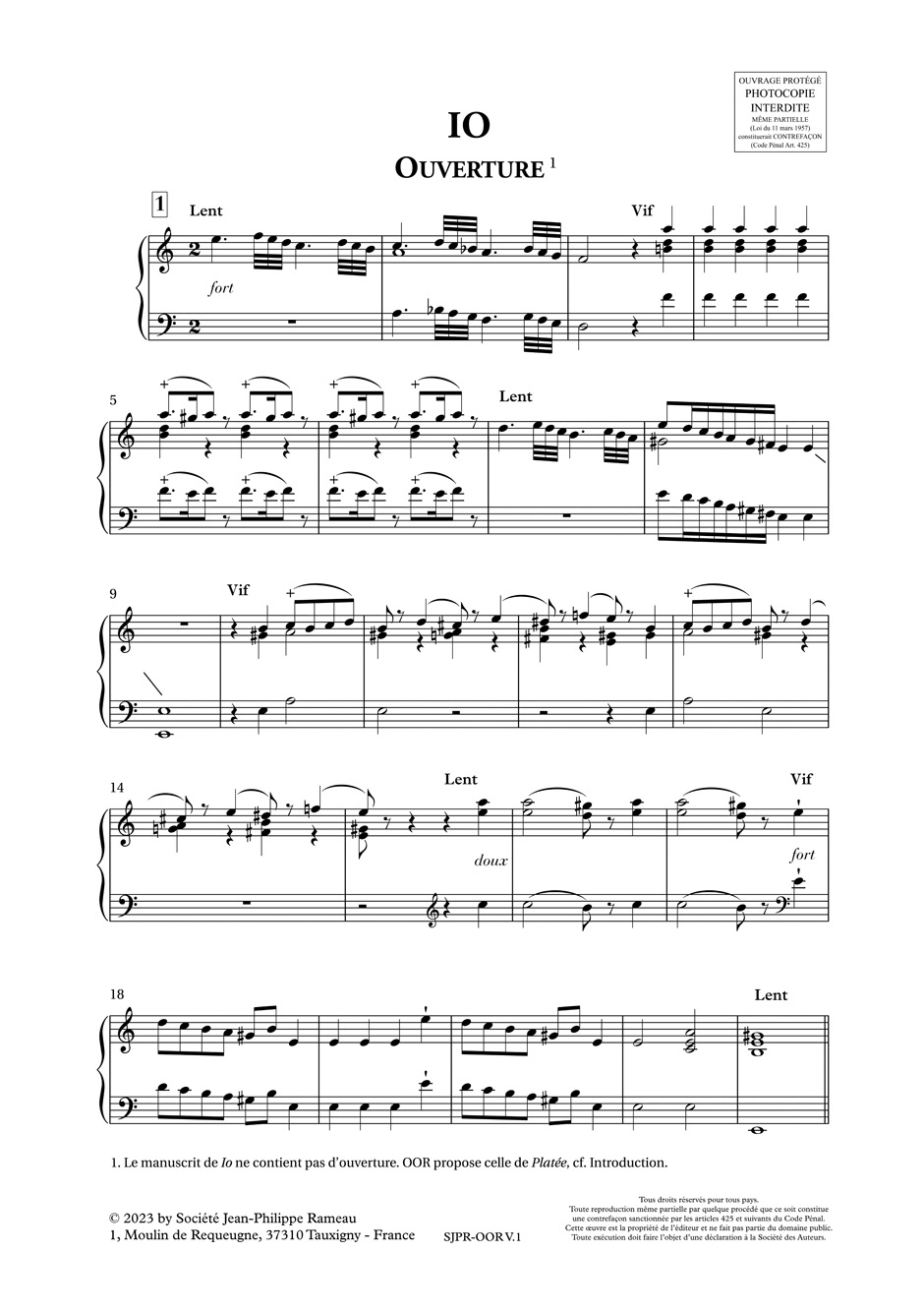
Ouverture
Scène I
Récitatif en dialogue. Mercure, Jupiter, "Dans les jardins d’Hébé, Junon vient de se rendre"
Air. Jupiter, "C’est à la jeune Io que j’ai rendu les armes"
Récitatif en dialogue. Mercure, Jupiter, "Blessé des mêmes traits, le dieu qui nous éclaire"
Air. Jupiter, "Trop abuser de la foiblesse"
Récitatif. Mercure, "La nymphe paroît en ces lieux"
Scène II
Air accompagné. Jupiter, "Du doux plaisir je suis la loi"
Air. Io, "Contre l’aimable enfant qu’on adore à Cythère"
Récitatif en dialogue. Jupiter, Io, "Accablé de votre rigueur Philémon m’apprend à le craindre."
Air. Jupiter, "La beauté la moins sévère"
Scène III
Air accompagné. Io, "Amour, dissipe son erreur"
Scène IV
Récitatif en dialogue. Apollon, Io, "Consumé loin de vous, de tristesse et d’amour"
Air accompagné. Apollon, "Le Soleil, touché de mes maux"
Récitatif. Jupiter, "Quoi ! c’est votre rigueur, ingrate"
Air. Io, "Ce langage flatteur, vous l’ignorez, Hilas"
Air. Io, "L’amant ingénieux, pour hâter son bonheur"
Air accompagné. Io, "C’est de nos rigueurs que murmure"
Air accompagné. Jupiter, "Dans un tendre lien"
Récitatif en dialogue. Apollon, Io, Jupiter, "Ma constance, mes soins, mes pleurs, rien ne vous touche"
Orage – Récitatif accompagné en dialogue. Io, Jupiter, "Quel bruit vient nous troubler ?"
Duo accompagné. Io, Apollon, "Jupiter, lance la foudre"
Continuation de l’Orage – Récitatif accompagné. Jupiter, "Cessez orage !"
Scène V
Récitatif en dialogue. Io, Jupiter, "Hilas est-il un dieu ? Ma surprise est extrême !"
Air. Jupiter, "Plus belle que Junon, régnez sur les mortels"
Air. Io, "Pour la reine des cieux, qu’ils gardent cet honneur"
Duo. Io, Jupiter, "Que tes feux toujours renaissans"
Récitatif. Jupiter, "Que tout prenne en ces lieux une forme nouvelle"
Scène VI
Entrée pantomime des Grâces, des Plaisirs et des Jeux
Scène VII
Récitatif. La Folie, "Trop heureux habitans de ce riant bocage"
Compléments empruntés à la version originale de Platée
Récitatif. La Folie, "Admirez tous mon art célébre"
Prélude – Ariette. La Folie, "Aux langueurs d’Apollon, Daphné se refusa"
Chœur accompagné. Grâces, Plaisirs et Jeux, "Honneur, honneur à la Folie" Récitatif. La Folie, "Jugez par du beau simple et des sons plus touchans"
Air accompagné. La Folie, "Que les Plaisirs les plus aimables"
Récitatif. La Folie, "Vous admirez mon art suprême"
Chœur accompagné. Grâces, Plaisirs et Jeux, "Honneur, honneur à la Folie"
Premier menuet pour les Grâces, les Plaisirs et les Jeux
Deuxième menuet pour les Grâces, les Plaisirs et les Jeux
Air pour les Grâces, les Plaisirs et les Jeux
Chœur accompagné. Grâces, Plaisirs et Jeux, "Chantons, célébrons en ce jour"
Chaconne pour les Grâces, les Plaisirs et les Jeux
In Rameau's operatic oeuvre, "Io" is certainly the work shrouded in the most mystery: the acte de ballet has survived only in the form of a copy of the score and parts which was made by a collector from the generation after Rameau from the autograph that now is lost. Although the copy seems to have been used, presumably for a trial read-through, the work was apparently never regularly performed during Rameau's lifetime. And for good reason: the work breaks off abruptly at the beginning of the divertissement; neither the librettist nor a plan for a theatre location are known. Because of its incompleteness, "Io" was long regarded as Rameau's last work, but there is much to suggest that the composition must have been written between 1740 and 1745. The introduction to this edition examines the references regarding the dating as well as various hypotheses about performance possibilities and librettists.
The plot revolves around one of those typical mythological flirtations that are inevitably to be expected when Jupiter and a nymph, here Io, are involved. With the appearance of madness, La Folia, the work reaches a dramaturgical climax. However after this, the opera breaks off. In order to make the piece performable, the editors of “Opera Omnia Rameau” propose an addition to the divertissement as well as an ending borrowed from the ballet bouffon "Platée" in its 1745 version, which shows numerous parallels to "Io". Thus, these additions come as close as possible to Rameau's style of the 1740s while bringing the plot to a conclusion.
편곡자 Saint-Yves, Francois
작곡가 Rameau, Jean-Philippe (1683-1764)
에디터 Soury, Thomas