Happy Present Meet
Birkenkotter bel Canto for Oboe solo
Solo instruments; stapled. Solo concerto; Music post-1945; New music (post-2000). Score.
Composed 2013/14
Duration 13'30
Belcanto is a term for the Italian art of singing which took its development from the richly ornamented solo vocalism of the early 17th century (“nobile maniera di cantare”) and dominated European operatic singing until the first half of the 19th century. Complete control over the voice meant not only legato and messa di voce, but also appoggiatura and portamento, as well as virtuoso ornamentation by means of coloratura (“canto fiorito”). This development towards utmost virtuosity, emulating instrumental playing techniques, led to a mannered, artificial style on the one hand, but on the other also emphasized the physical aspects of interpretation (castrati were considered the ideal belcanto singers). And today? In his essay “The Grain of the Voice,” Roland Barthes writes: “The grain is the body in the voice as it sings, the hand as it writes and the limb as it performs.” Initially, he refers to the friction between language and voice in singing, but then transfers his thoughts to the physicality of instrumental music.
In this spirit, I went in search of “beautiful singing,” a beauty which perhaps results in the very place where the grain, the roughness, meaning also physical resistance, are not smoothed over.
The oboe seemed very suitable to me for singing with such a “physical expressivity,” as a very unruly instrument!
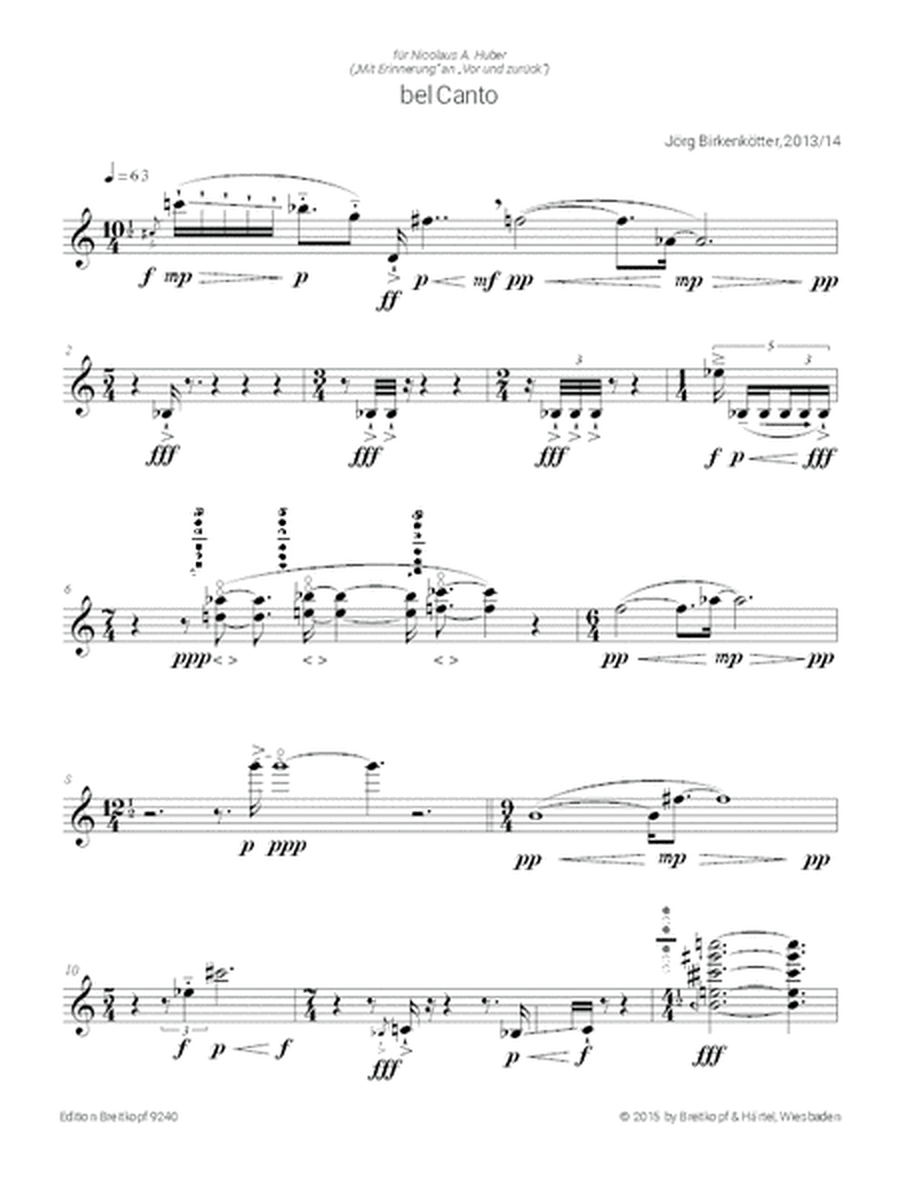
The backbone of my piece is one single, quasi endless melodic line, consisting of intervals that are constantly pulled apart and contracted again (breathing). Many different actions attach themselves to these notes: coloratura, trills, chords (multiphonics), double flageolets. However, there are not only sound types, but also impulses, repetitions, rhythmic figures and other elements: composed elements of belcanto.
In the opera tradition described above, these were improvised ornaments or additions; here they become composed figures which originate with the notes of the melody, but also pull on them, bend them, and “charge them with physicality.”
(Jörg Birkenkötter)
벨칸토(Belcanto)는 17세기 초의 화려하게 장식된 독창 성악("nobile maniera di cantare")에서 발전하여 19세기 전반까지 유럽 오페라 노래를 지배했던 이탈리아 노래 예술을 가리키는 용어입니다. 성악을 완벽하게 제어한다는 것은 레가토와 메사 디보세뿐 아니라 아포지아투라와 포르타멘토, 그리고 콜로라투라(“canto fiorito”)를 통한 거장 장식도 의미했습니다. 기악 연주 기술을 모방하면서 최고의 기교를 향한 이러한 발전은 한편으로는 예의바르고 인위적인 스타일로 이어졌지만 다른 한편으로는 해석의 신체적 측면도 강조했습니다(카스트라토는 이상적인 벨칸토 가수로 간주되었습니다). 그리고 오늘? 롤랑 바르트(Roland Barthes)는 자신의 에세이 "목소리의 결(The Grain of the Voice)"에서 다음과 같이 썼습니다. "곡물은 노래하는 목소리의 몸이고, 글을 쓰는 손이며, 연주하는 팔다리입니다." 처음에 그는 노래에서 언어와 목소리 사이의 마찰을 언급하지만, 나중에는 그의 생각을 기악의 물리적 특성으로 옮깁니다.
이런 마음으로 나는 '아름다운 노래'를 찾아 나섰는데, 그 아름다움은 결이, 거칠음이, 곧 물리적인 저항이 다듬어지지 않은 바로 그 자리에서 나타나는 것일지도 모른다.
오보에는 매우 다루기 힘든 악기로서 "신체적 표현력"을 가지고 노래하는 데 매우 적합한 것 같았습니다!
내 작품의 중추는 끊임없이 분리되고 다시 수축되는 간격(호흡)으로 구성된 하나의 단 하나의 준끝없는 멜로디 라인입니다. 콜로라투라, 트릴, 화음(다중 성악), 이중 깃발 등 다양한 동작이 이러한 음표에 연결됩니다. 그러나 벨칸토에는 소리의 유형뿐만 아니라 충동, 반복, 리듬적 형태 및 기타 요소도 있습니다. 구성 요소는 벨칸토입니다.
위에서 설명한 오페라 전통에서 이는 즉흥적으로 장식하거나 추가한 것이었습니다. 여기에서 그들은 멜로디의 음표에서 유래하지만 또한 그것을 잡아당기고 구부리고 “신체성을 충전”하는 구성된 형상이 됩니다.
(요르그 비르켄코터)
작곡가 Birkenkotter, Jorg