Happy Present Meet
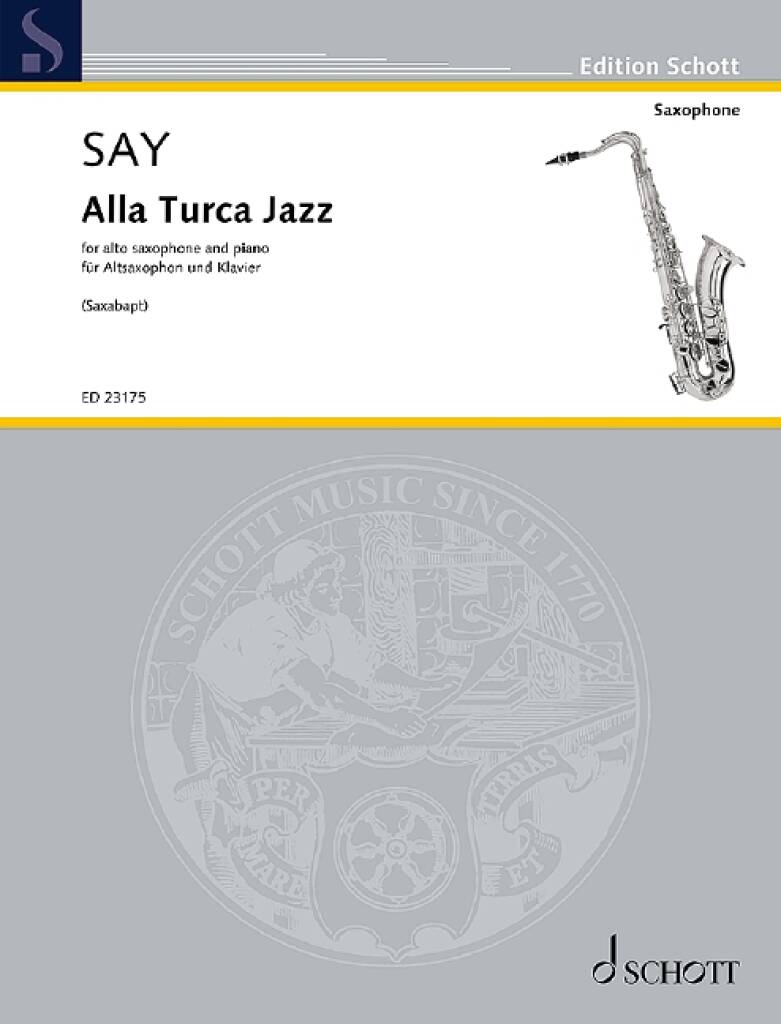
Say Alla Turca Jazz op. 5b for Alto Saxophone and Piano
사이 알라 투르카 재즈 Op.5b 알토 색소폰과 피아노
Fantasia on the Rondo from the Piano Sonata in A major K. 331 by Wolfgang Amadeus Mozart
Version for alto saxophone and piano by Saxabapt (2018)
based on the original version for piano (1993)
Duration: 2 ′
Levels : Advanced
The final movement of the Sonata in A major KV 331 by Wolfgang Amadeus Mozart, the Rondo Alla Turca, is one of the most famous piano pieces of all time. Once only familiar to musical experts, later a universal piece for all piano pupils, its opening melody is now even omnipresent as an alienated sinus tone-like mobile phone ring tone.
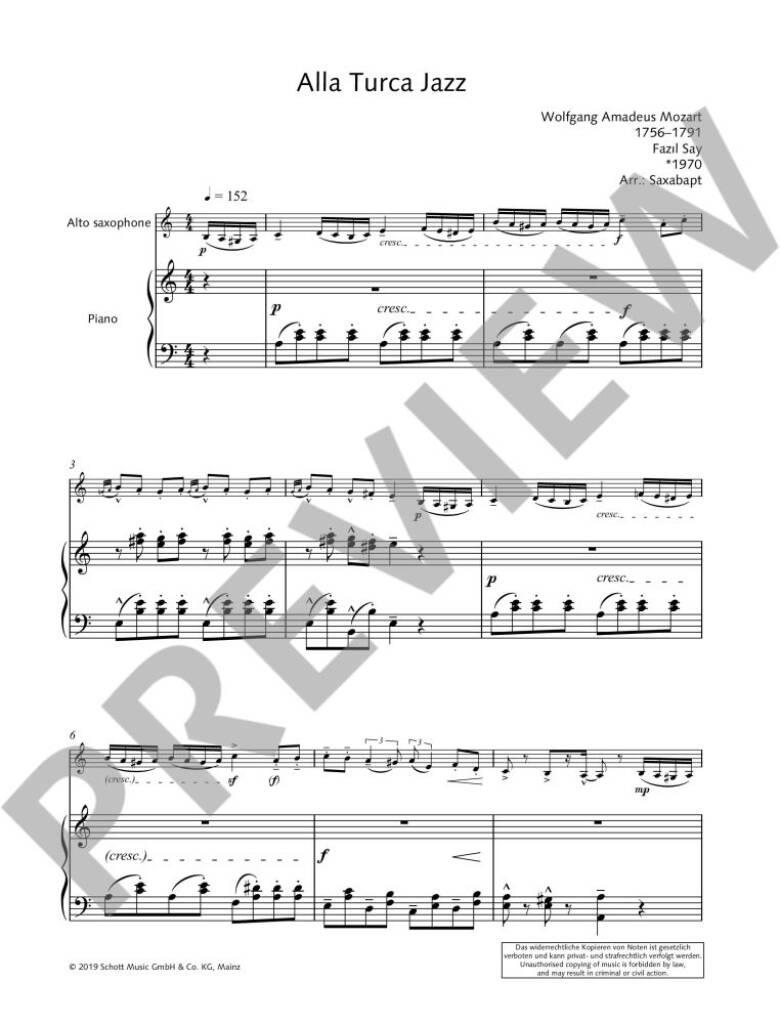
Fazıl Say's arrangement, originally created as an effective encore, follows on from this popularity. After the first eight bars have been presented in original form, typical elements of jazz superimposed on the still recognisable classical foundations can be discovered, such as syncopation of the top notes and ornamentation through chromatic blue notes, embedded in the at times frenzied chains of semiquavers. In the spirit of the work's improvisatory character, Say likes to perfom his Alla Turca Jazz in different combinations, for example accompanied by jazz singers of with orchestra.
It may appear strange that Fazıl Say, who was born in Turkey and - when not on tour - is still resident in that country, does not bring back Mozart's interpretation of genuine Turkish music closer to its own roots, particularly as many of his compositions such as Black Earth or the Violin Sonata are characterised by a subtle amalgamation of the Classical-Romantic tradition, Turkish folk music and elements of jazz. In a further Mozart arrangement, the ballet music Patara premiered in Vienna in 2006, composed on the basis of the Rococo-like theme from the first movement of the same A-major Sonata (wich enjoys almost as great popularity as the Alla Turca theme), Say utilised the connection which was absent in Alla Turca, albeit in the opposite direction. In the ballet music, the piano symbolises Western culture and the Ney flute Oriental culture, communcated atmosperically by austere percussion instrumentation and soprano vocalisation.
The present arrangement now also includes a version for alto saxophone and piano.
볼프강 아마데우스 모차르트의 A장조 소나타 KV 331의 마지막 악장인 론도 알라 투르카는 역대 가장 유명한 피아노 작품 중 하나입니다. 한때는 음악 전문가에게만 익숙했지만, 나중에는 모든 피아노 학생에게 보편적인 작품이 된 이 곡의 오프닝 멜로디는 이제 소외된 사인 톤과 같은 휴대전화 벨소리로 널리 알려져 있습니다.
원래 효과적인 앙코르로 만들어진 파질 세이의 편곡은 이러한 인기를 이어갑니다. 처음 8마디가 원래 형태로 제시된 후, 여전히 알아볼 수 있는 고전적인 기초 위에 중첩된 재즈의 전형적인 요소를 발견할 수 있습니다. 예를 들어, 최고 음표의 싱코페이션과 반음계적 블루 노트를 통한 장식음은 때때로 열광적인 16분음표의 사슬에 포함되어 있습니다. 세이는 즉흥 연주적 성격의 작품 정신에 따라 다양한 조합으로 알라 투르카 재즈를 연주하는 것을 좋아하는데, 예를 들어 오케스트라와 함께 재즈 가수가 반주합니다.
터키에서 태어나 투어를 하지 않을 때는 여전히 그 나라에 거주하는 파질 세이가 모차르트의 정통 터키 음악 해석을 그 뿌리에 더 가깝게 되돌리지 않는 것은 이상하게 보일 수 있습니다. 특히, 검은 땅이나 바이올린 소나타와 같은 그의 많은 작곡이 고전-낭만주의 전통, 터키 민속 음악, 재즈 요소를 미묘하게 혼합한 것이 특징이기 때문입니다. 모차르트의 또 다른 편곡으로, 2006년 비엔나에서 초연된 발레 음악 파타라는 발레 음악은 같은 A장조 소나타의 첫 악장에서 나온 로코코풍 테마를 바탕으로 작곡되었습니다(알라 투르카 테마만큼 큰 인기를 누림). 세이는 알라 투르카에서 빠진 연결을 활용했지만, 그 반대 방향이었습니다. 발레 음악에서 피아노는 서양 문화를 상징하고, 네이 플루트는 동양 문화를 상징하며, 엄격한 타악기 연주와 소프라노 보컬로 분위기 있게 전달합니다.
현재의 편곡에는 알토 색소폰과 피아노 버전도 포함되었습니다.
편곡자 Saxabapt
작곡가 Say, Fazil