
Happy Present Meet
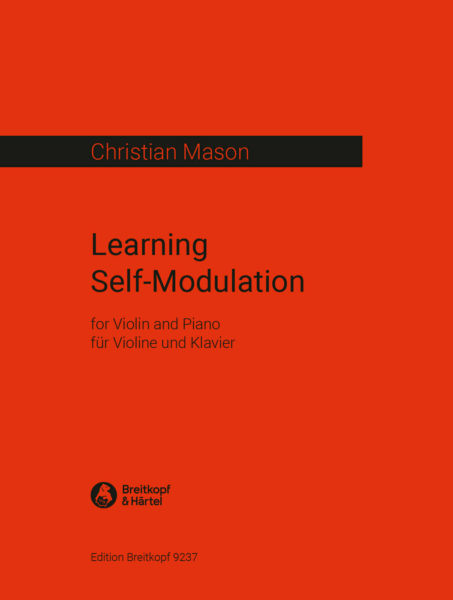
Mason Learning Self-Modulation for Violin and Piano
자기 조절 학습
2011
Duration: 22'
Wolrd premiere: Paris/France, Musée du Louvre, October 14, 2011
세계 초연: 파리/프랑스, 루브르 박물관, 2011년 10월 14일
Table of Contents
1. Dancing through the thunderous night
2. Azure flashes falling
3. Through suspended mists of white
4. Seeking realms forever bright
5. We hear the timeless calling
6. And here at last, we flow like light
Learning Self-Modulation is a piece in which two musicians take us on a journey of transformation and shifting perspective. Rather than existing in opposition, the violin and piano are conceived as interlocking facets of the same identity, the shifting balance of their energies forming the musical drama of this piece. Of course, their differences as instruments could hardly be greater – one so small the other so grand, not to mention playing techniques and sound qualities. It is through their varied interactions, and their aspiration to unity, that the music flows through many states of being towards integration and repose. Despite the changes of character and energy that we experience, the musical materials remain of the same substance, and at the harmonic level at least there is underlying unity across the work, with hints of modality and tonality emerging gradually from the midst of the initial chromaticism.
Poetically speaking, there is an evolution from a visceral, electrified 'thunderous night' into a calm, contemplative 'place of light'. Each of the six movements takes a subtitle from the following poem, which charts this journey:
Learning Self-Modulation은 두 음악가가 우리를 변형과 관점의 여정으로 인도하는 작품입니다. 바이올린과 피아노는 대립하는 것이 아니라 동일한 정체성의 상호 연결된 측면으로 구상되며, 에너지의 균형이 변하면서 이 작품의 음악적 드라마가 형성됩니다. 물론 악기로서의 그들의 차이점은 더 클 수 없을 것입니다. 하나는 너무 작고 다른 하나는 너무 큽니다. 연주 기법과 사운드 품질은 말할 것도 없습니다. 다양한 상호 작용과 통합에 대한 열망을 통해 음악은 통합과 휴식을 향해 여러 상태를 거칩니다. 우리가 경험하는 성격과 에너지의 변화에도 불구하고 음악적 소재는 동일한 본질로 유지되며 적어도 하모닉 수준에서는 작품 전체에 기본적인 통합이 있으며, 초기 색채주의의 한가운데에서 점차적으로 모달리티와 음조의 힌트가 나타납니다.
시적으로 말하면, 내장적이고 전기적인 '천둥치는 밤'에서 차분하고 사색적인 '빛의 장소'로 진화합니다. 6개의 각 악장은 이 여정을 나타낸 다음 시에서 부제를 따왔습니다.
The notion of transformation is also embodied in the progressive de-tuning of the violin during the first four movements. Eventually, in the last two movements, this slightly de-tuned violin is replaced by a fully transformed scordatura violin, strung with four de-tuned G-strings. Once this sounds, we find ourselves in a new world...
Learning Self-Modulation is dedicated to Carolin Widmann whose generous and adventurous spirit was an inspiration to me throughout the time of composition.
(Christian Mason 2011)
변형의 개념은 또한 처음 네 악장에서 바이올린의 점진적인 튜닝 해제에 구현됩니다. 결국 마지막 두 악장에서 약간 튜닝이 해제된 이 바이올린은 튜닝이 해제된 네 개의 G-현이 있는 완전히 변형된 스코르다투라 바이올린으로 대체됩니다. 이것이 들리면 우리는 새로운 세계에 있는 자신을 발견하게 됩니다...
Learning Self-Modulation은 작곡하는 동안 저에게 영감을 준 관대하고 모험적인 정신을 가진 캐롤린 위드만에게 바칩니다.
작곡가 Mason, Christian