Happy Present Meet
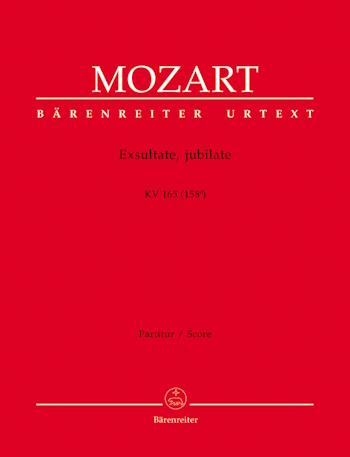
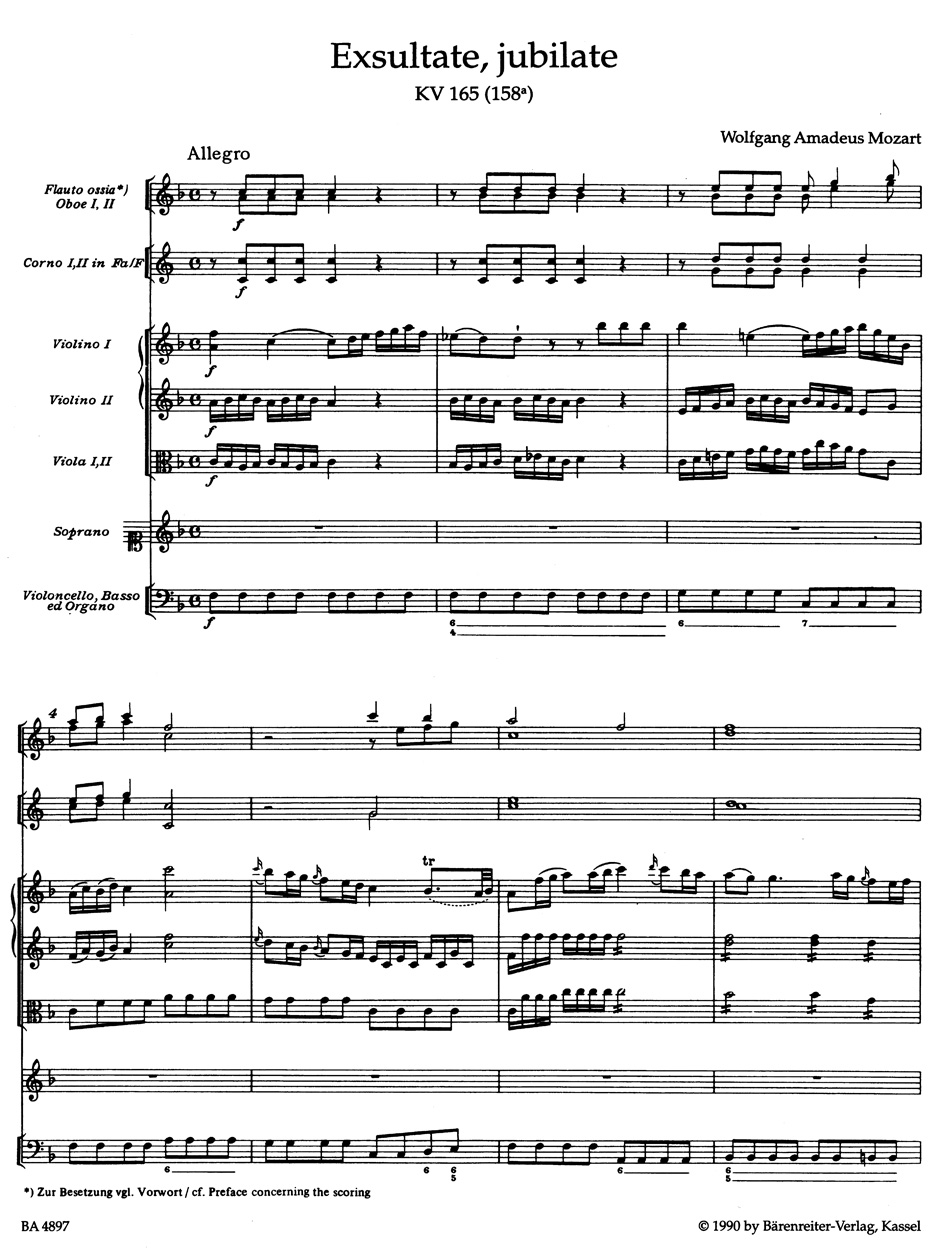
Mozart Exsultate, Jubilate K.165 (158a) for Full score
Soprano solo, Orchestra
Detailed instrumentation: Soprano solo, Oboe (2) (Flute (2)), Horn (2), Violin (2), Viola (2), Violoncello, Basso, Organ
Editor: Federhofer, Hellmut / Münster, Robert
Product format: Score, Urtext edition
Comments on the edition: Edited with additional material from the Salzburg version
Duration (approx.): 00:17:00
Motet
“In Italy nowadays this term (motet) is applied to a Latin sacred solo cantata consisting of two arias and two recitatives, concluding with an Hallelujah, and sung during the Mass following the Credo, generally by one of the best singers.” One composition matching this description is the solo motet Exsultate, jubilate, K. 165/158a, which Mozart wrote in Milan early in 1773 following the highly successful performance of his opera Lucio Silla.
In 1978, when the music manuscripts in Bavaria were being sorted and cataloged in a project sponsored by the Deutsche Forschungsgemeinschaft, a set of manuscript parts for a previously unknown second version was discovered in the town parish church of St. Jakob in Wasserburg am Inn. The music and text of the concluding Alleluja movement were written out by the Salzburg court bassoonist and copyist Joseph Richard Estlinger (c. 1720–1791), who frequently worked for Mozart and his father.
The vocal text of this Salzburg manuscript departs from that of the Milan version in the first aria and in the recitative. It was entered in a different hand. The Salzburg version of the text is clearly related to the feast of the Holy Trinity. There is much evidence that this version was sung for the first time in the Dreifaltigkeitskirche on 30 May 1779 (i. e. Trinity Sunday) by the Salzburg male soprano Francesco Ceccarelli during a service mentioned by Nannerl Mozart. On that day Leopold and Wolfgang Mozart, together with Ceccarelli, were invited to the church’s vicarage at midday. The additional text underlaying of the first aria enabled the solo motet to be employed for the Christmas service as well.
“현재 이탈리아에서 이 용어(모테트)는 두 개의 아리아와 두 개의 레치타티브로 구성된 라틴 성스러운 솔로 칸타타에 적용되며, 할렐루야로 마무리되고 크레도에 이어 미사 중에 부르며, 일반적으로 최고의 가수 중 한 명이 부릅니다.” 이 설명과 일치하는 작품 중 하나는 솔로 모테트 Exsultate, jubilate, K. 165/158a로, 모차르트가 오페라 루치오 실라의 대성공을 거둔 후 1773년 초 밀라노에서 작곡했습니다.
1978년, 독일 연구 협회가 후원하는 프로젝트에서 바이에른의 악보를 분류하고 카탈로그화하던 중, 이전에 알려지지 않았던 두 번째 버전의 악보 부분 세트가 바서부르크 암 인의 성 야콥 교구 교회에서 발견되었습니다. 마지막 알렐루야 악장의 음악과 텍스트는 모차르트와 그의 아버지를 위해 자주 일했던 잘츠부르크 궁정 바순 연주자이자 필사자 요제프 리하르트 에스틀링거(1720년경~1791년)가 썼습니다.
이 잘츠부르크 사본의 보컬 텍스트는 첫 번째 아리아와 레치타티보에서 밀라노 버전과 다릅니다. 다른 필사본으로 작성되었습니다. 텍스트의 잘츠부르크 버전은 분명히 삼위일체 축일과 관련이 있습니다. 이 버전이 1779년 5월 30일(즉, 삼위일체 일요일) 드라이팔티크카이츠키르헤에서 난네를 모차르트가 언급한 예배에서 잘츠부르크 남성 소프라노 프란체스코 체카렐리가 처음으로 불렀다는 증거가 많이 있습니다. 그날 레오폴트와 볼프강 모차르트는 체카렐리와 함께 정오에 교회의 사제관으로 초대되었습니다. 첫 번째 아리아에 추가적인 가사가 삽입되어서 이 솔로 모테트를 크리스마스 예배에도 사용할 수 있게 되었습니다.
작곡가 Mozart, Wolfgang Amadeus (1756-1791)
에디터 Federhofer, Hellmut
Munster, Robert