Happy Present Meet
Schubert Mass in G major D 167 for Vocal Score
Performance material based on the latest research of the “New Schubert Edition”
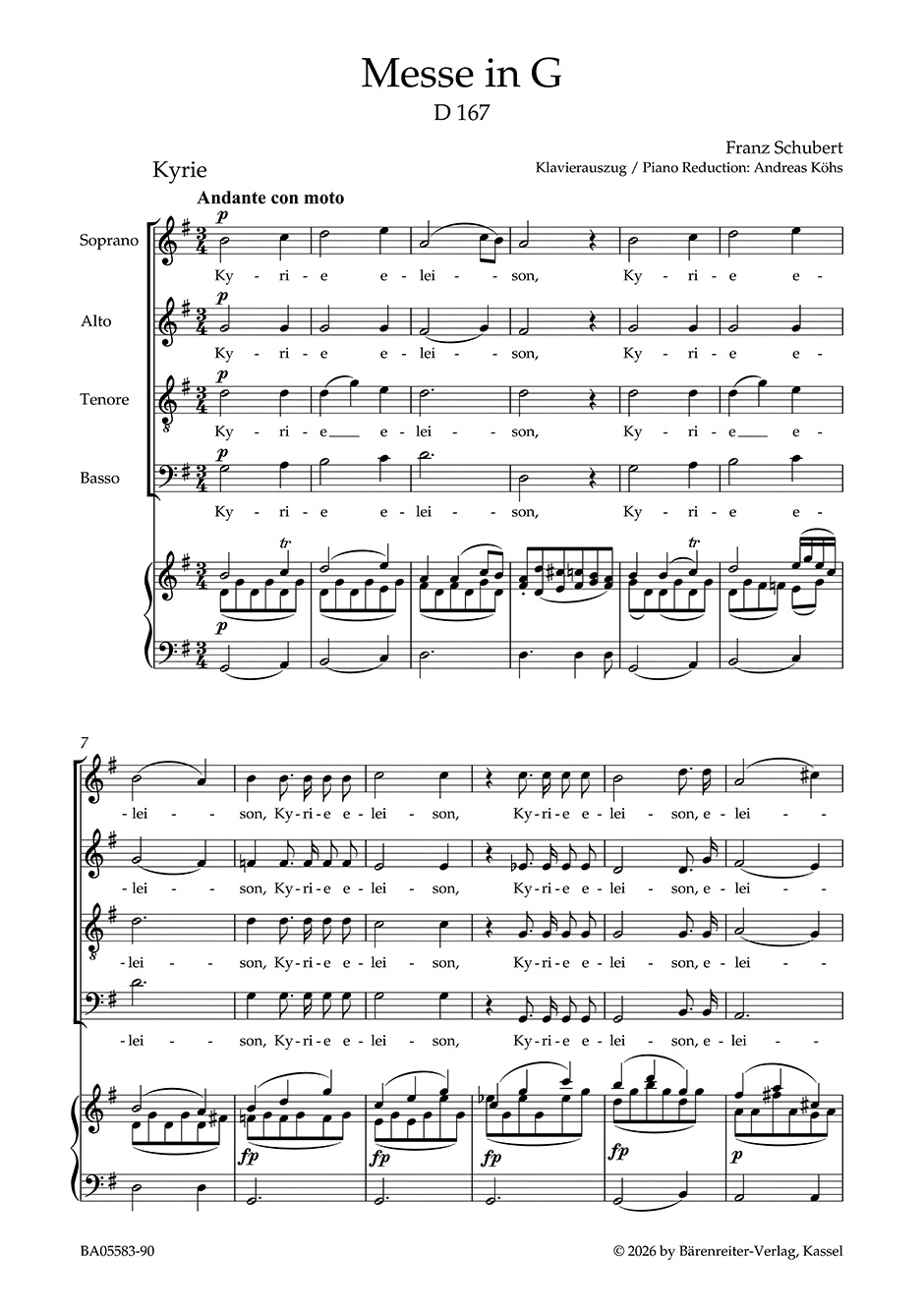
Well-arranged piano reduction
Scoring:Soloists, Choir, Orchestra
Instrumentation in detail:
Soprano solo, Tenor solo, Bass solo, Mixed choir (SATB), Trumpet ad libitum (2), Timpani ad libitum, Strings, Organ
Editor:Martin, Christine
Foreword / Introduction:Martin, Christine
Arranger:Köhs, Andreas
Product format:Vocal Score, Urtext edition
Language of the work:Latin
Languages of the text:German, English
Content
Composer / Author:Martin, Christine
Title:Vorwort
Composer / Author:Martin, Christine
Title:Preface
Kyrie
Gloria
Credo
Sanctus
Benedictus
Agnus Dei
Franz Schubert composed the Mass in G major D 167 in March 1815. Only six months earlier, he made his public debut as a composer with his first Mass in F major D 105. Although no specific occasion for the composition of the second mass is known, it was most likely written for Schubert’s home parish in Lichtental (now a district of Vienna), where it was also first performed.
The original version of the Mass in G major was intended for string instruments only. Shortly afterwards, however, Schubert added trumpets and timpani ad libitum in a revised second version, which also forms the basis of this edition. The expanded instrumentation was probably intended for a festive church occasion – possibly one of the Easter days of 1815.
프란츠 슈베르트는 1815년 3월에 G장조 미사곡 D 167을 작곡했습니다. 불과 6개월 전인 1815년, 그는 첫 번째 미사곡인 F장조 미사곡 D 105로 작곡가로서 공식 데뷔를 했습니다. 두 번째 미사곡의 작곡 배경은 정확히 알려져 있지 않지만, 슈베르트의 고향인 리히텐탈(현재 빈의 한 지역) 교구에서 초연되었을 가능성이 가장 높습니다.
G장조 미사곡의 원곡은 현악기만을 위한 것이었습니다. 그러나 얼마 지나지 않아 슈베르트는 트럼펫과 팀파니를 자유롭게 사용할 수 있도록 수정된 두 번째 버전을 발표했는데, 이 악보집 역시 이 수정된 버전을 기반으로 합니다. 악기 편성이 확장된 것은 아마도 축제 분위기의 교회 행사, 예를 들어 1815년 부활절 중 하나를 위한 것이었을 것입니다.
편곡자 Kohs, Andreas
작곡가 Schubert, Franz(1797-1828)
에디터 Martin, Christine