
Happy Present Meet
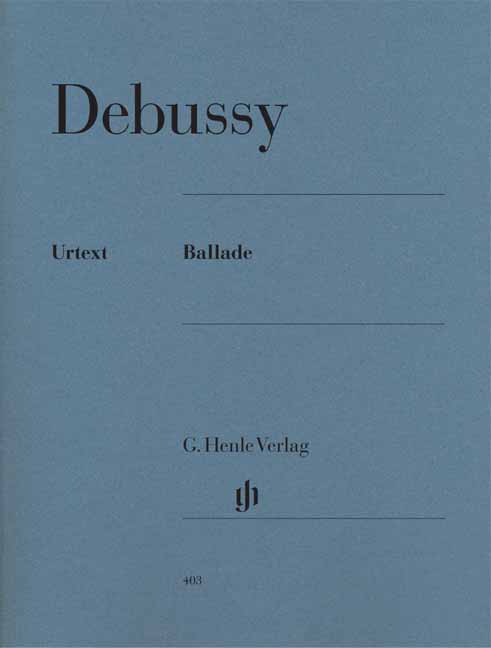
Debussy Ballade for Piano Solo
드뷔시 발라드 피아노 독주(솔로)
악기 구성
Piano Solo 피아노 독주(솔로)
Ernst-Gunter Heinemann (Editor) 에른스트귄터 하이네만
Hans-Martin Theopold (Fingering Piano) 한스마르틴 테오폴트
François Lesure (Preface) 프랑수아 르쥐르
Urtext Edition, paperbound
Pages 15 (IV+11)
Content
Ballade 발라드
6 medium
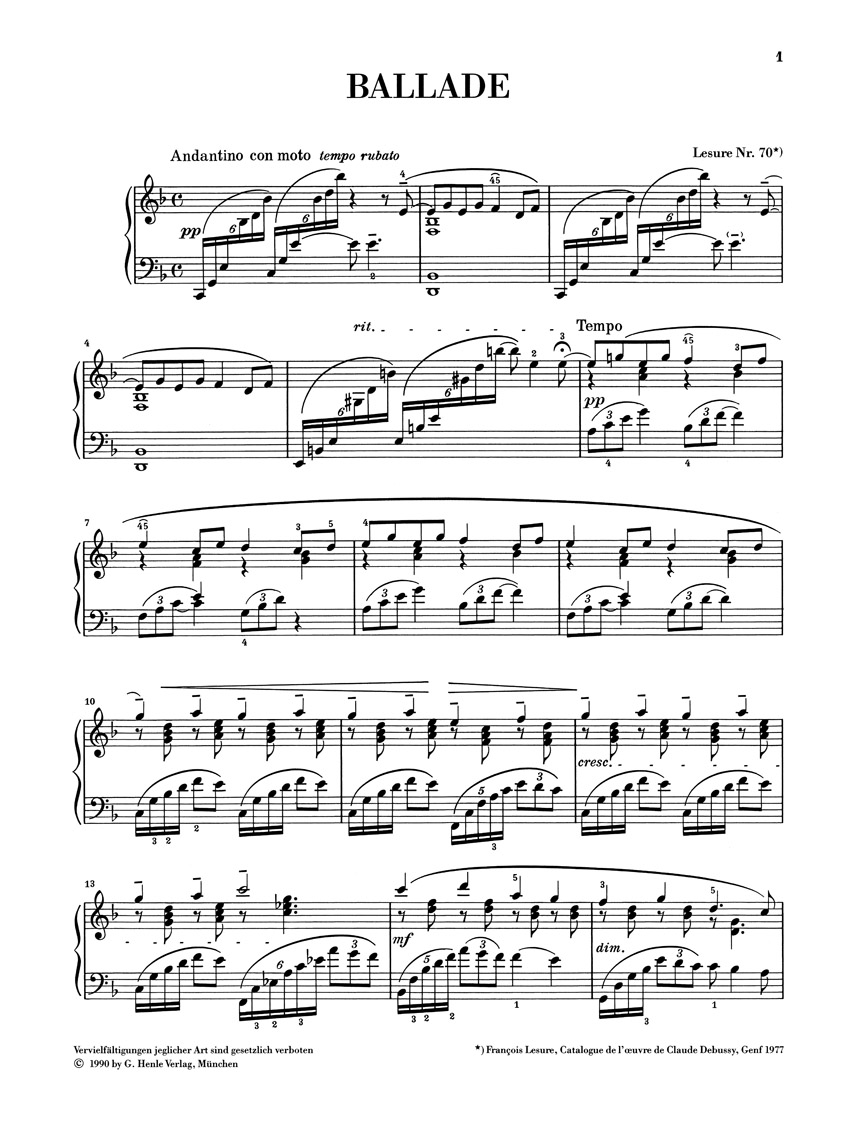
In autumn 1891 Debussy’s early piano piece, Ballade slave, was published by Choudens. When he had it re-engraved by Fromont in a slightly revised form in 1903, he deleted the word slave. Thus the title pointed more markedly to the work’s narrative character. Yet one can detect a certain Russian influence, stemming from the time he spent with Nadeshda von Meck – Debussy was at times her house pianist. Even echoes of Balakirev can be heard. The occasionally unconventional tonal approach already heralds the Debussy of the important cycle Pour le Piano, published in 1901.
1891년 가을, 드뷔시의 초기 피아노곡 「슬라브 발라드(Ballade slave)」가 슈당에서 출판되었습니다. 1903년 그가 이 곡을 약간 수정해 프로몽에서 새로 판각하게 했을 때, 「슬라브(slave)」라는 단어를 지웠습니다. 이로써 제목은 작품의 서사적 성격을 더욱 뚜렷하게 가리키게 되었습니다. 그럼에도 이 곡에서는 드뷔시가 나데즈다 폰 메크 곁에서 지내던 시절에서 비롯된 일정한 러시아의 영향을 느낄 수 있습니다. 드뷔시는 한때 그녀의 전속 피아니스트였습니다. 발라키레프의 메아리마저 들립니다. 때때로 나타나는 파격적인 음향 처리는 1901년에 출판된 중요한 모음곡 「피아노를 위하여(Pour le Piano)」의 드뷔시를 이미 예고합니다.
작곡가 Debussy, Achille Claude (1862-1918)
에디터 Heinemann, Ernst-Gunter
Debussy 6 Epigraphes Antiques for Piano Solo
파데레프스키편 제10권 : 쇼팽 마주르카 (Paderewski : Chopin Mazurkas)
Chopin Piano Concertos (Op.11 / Op.21) for 2 Pianos 4 Hands (Paderewski)
Kapustin Sinfonietta in C major Op.49 for Piano 4 Hands
Schubert Wanderer Fantasy (방랑자환타지) in C major Op.15 D 760 for Piano Solo