Happy Present Meet
Debussy 6 Epigraphes Antiques for Piano Solo
드뷔시 6개의 고대 비명 피아노 독주(솔로)
악기 구성
Piano Solo 피아노 독주(솔로)
Ernst-Gunter Heinemann (Editor) 에른스트귄터 하이네만
Hans-Martin Theopold (Fingering Piano) 한스마르틴 테오폴트
François Lesure (Preface) 프랑수아 르쥐르
Urtext Edition, paperbound
Pages 30 (V+25)
Content
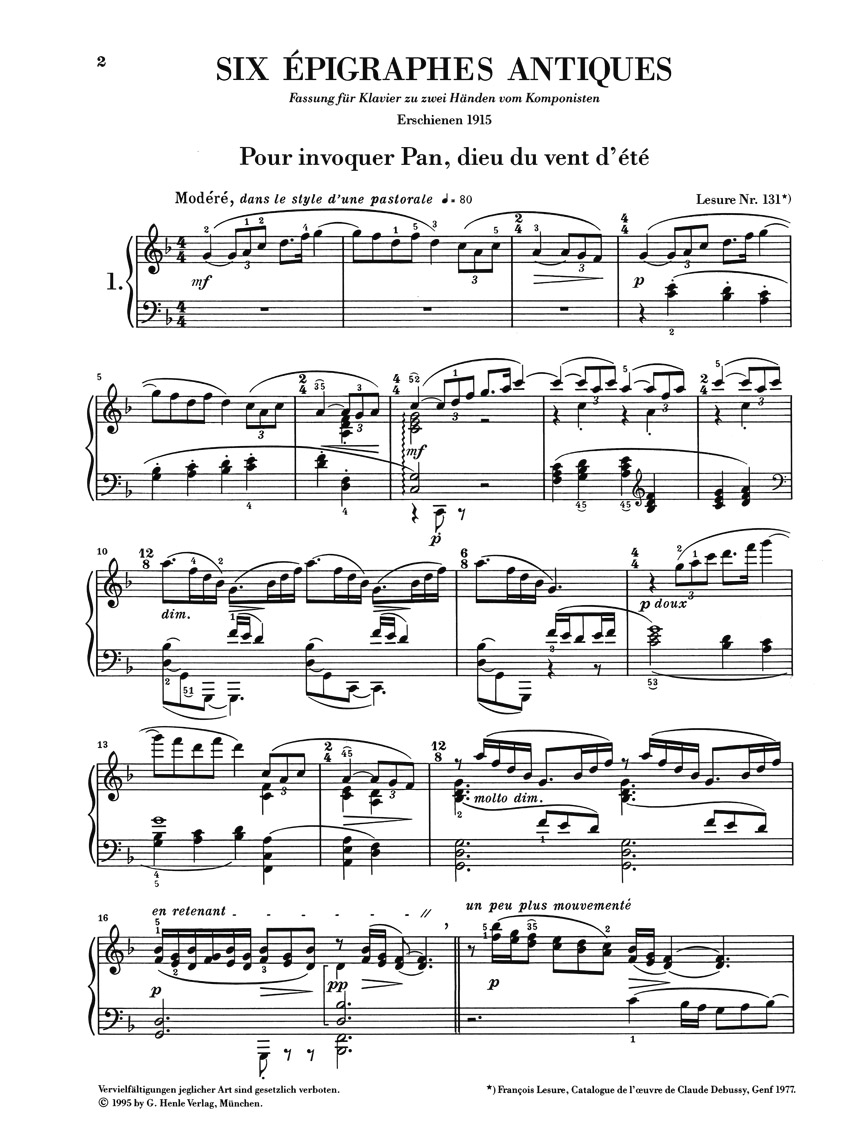
Pour invoquer Pan, dieu du vent d'été 여름 바람의 신 판을 부르기 위하여
6 medium
Pour l'Egyptienne 이집트 여인을 위하여
6 medium
Pour la danseuse aux crotales 크로탈을 든 무희를 위하여
7 difficult
Pour que la nuit soit propice 밤이 호의적이도록
7 difficult
Pour remercier la pluie au matin 아침 비에 감사하기 위하여
7 difficult
Pour un tombeau sans nom 이름 없는 무덤을 위하여
6 medium
Around 1900 Debussy composed 12 short pieces for two flutes, two harps and celesta as incidental music for the Chansons de Bilitis (recitation of ancient Greek poems by the courtesan Bilitis) by Pierre Louÿs. Although it was performed, the work was not published during Debussy’s lifetime. The composer highly valued the work and returned to it in 1914, choosing six of the old pieces and reworking them into an important new cycle for piano four hands (HN 408). At the same time he also completed a version for piano solo (HN 402). Debussy succeeded to transform the delicate incidental music into a colourful, sonorous piano setting in both versions.
1900년 무렵 드뷔시는 피에르 루이스의 「빌리티스의 노래(Chansons de Bilitis)」(고급 창부 빌리티스의 고대 그리스 시 낭송)를 위한 부수음악으로, 플루트 2대, 하프 2대, 첼레스타를 위한 짧은 곡 12곡을 작곡했습니다. 이 작품은 공연은 되었지만 드뷔시 생전에 출판되지는 않았습니다. 작곡가는 이 작품을 높이 평가해 1914년에 다시 손을 댔고, 옛 곡 가운데 6곡을 골라 피아노 연탄을 위한 중요한 새 모음곡(HN 408)으로 고쳐 썼습니다. 동시에 피아노 독주 버전(HN 402)도 완성했습니다. 드뷔시는 두 버전 모두에서 섬세한 부수음악을 다채롭고 풍부한 울림의 피아노 작품으로 바꾸어 내는 데 성공했습니다.
작곡가 Debussy, Achille Claude (1862-1918)
에디터 Heinemann, Ernst-Gunter