Happy Present Meet
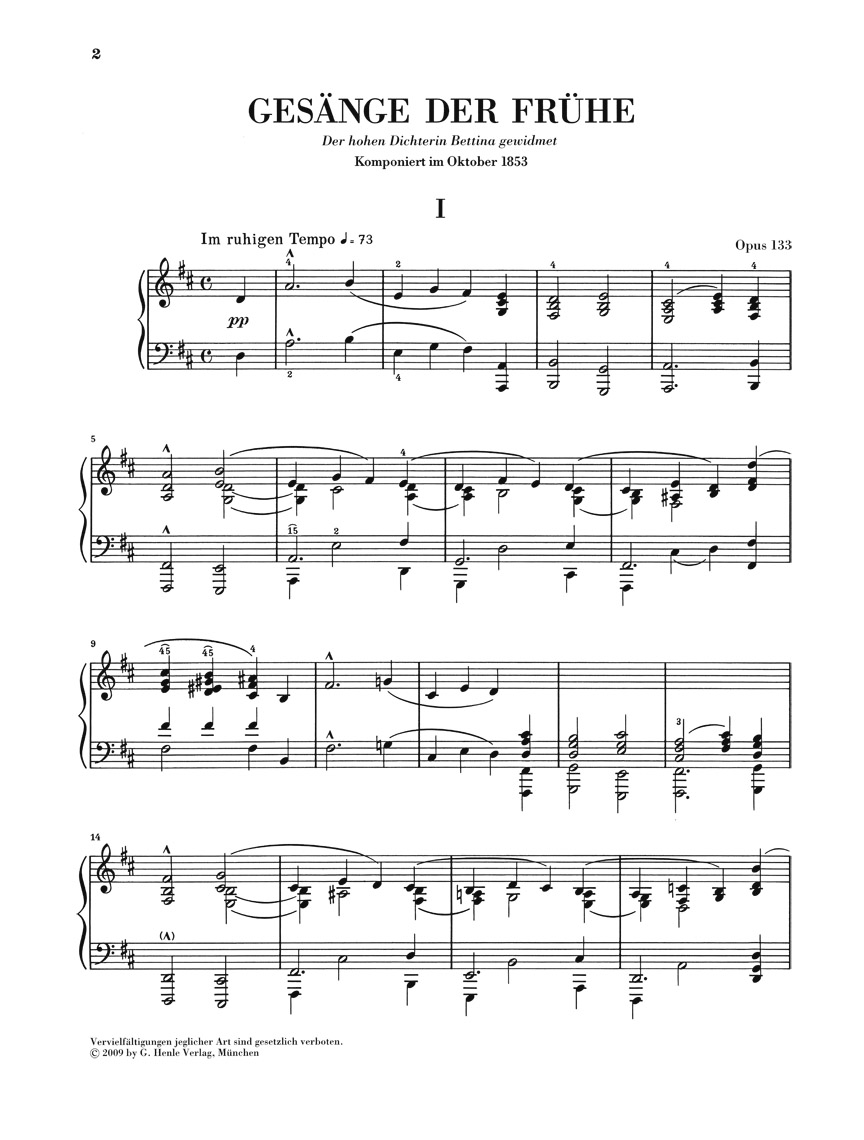
Schumann Gesange der Fruhe Op.133 for Piano Solo
슈만 새벽의 노래 Op.133 피아노 독주(솔로)
악기 구성
Piano Solo 피아노 독주(솔로)
Ernst Herttrich (Editor) 에른스트 헤르트리히
Hans-Martin Theopold (Fingering Piano) 한스마르틴 테오폴트
Urtext Edition, paperbound
Pages 30 (VII+23)
Content
Gesange der Fruhe Op.133 No.1 새벽의 노래
6 medium
Gesange der Fruhe Op.133 No.2 새벽의 노래
7 difficult
Gesange der Fruhe Op.133 No.3 새벽의 노래
7 difficult
Gesange der Fruhe Op.133 No.4 새벽의 노래
7 difficult
Gesange der Fruhe Op.133 No.5 새벽의 노래
7 difficult
“To Diotima” – this addendum to the title was preserved until shortly before publication of the piano “songs” and mystified Schumann’s contemporaries. “The Goddess to whom they are addressed has caused me quite a headache” wrote Joseph Joachim, and even Brahms was not able to identify her. The composer was referring to a novel by Holderlin, although this work was apparently no longer generally very well-known in Schumann’s day. “Quite original pieces, there is a very particular atmosphere in them” – thus Clara passed judgement. In our revised edition Ernst Herttrich provides a detailed illumination of the background to this unusual work.
「디오티마에게」 — 이 부제는 피아노 “노래”의 출판 직전까지 남아 있었고, 슈만과 동시대 사람들을 어리둥절하게 했습니다. “이 곡들이 바쳐진 여신 때문에 머리가 꽤 아팠습니다”라고 요제프 요아힘은 썼고, 브람스조차 그 정체를 밝히지 못했습니다. 작곡가가 가리킨 것은 횔덜린의 소설이었지만, 이 작품은 슈만 시대에는 이미 일반에 그리 잘 알려져 있지 않았던 것으로 보입니다. “아주 독창적인 곡들이며, 그 안에는 매우 독특한 분위기가 있다” — 클라라는 이렇게 평했습니다. 이 개정판에서 에른스트 헤르트리히는 이 특이한 작품의 배경을 자세히 밝혀 줍니다.
작곡가 Schumann, Robert (1810-1856)
에디터 Herttrich, Ernst