Happy Present Meet

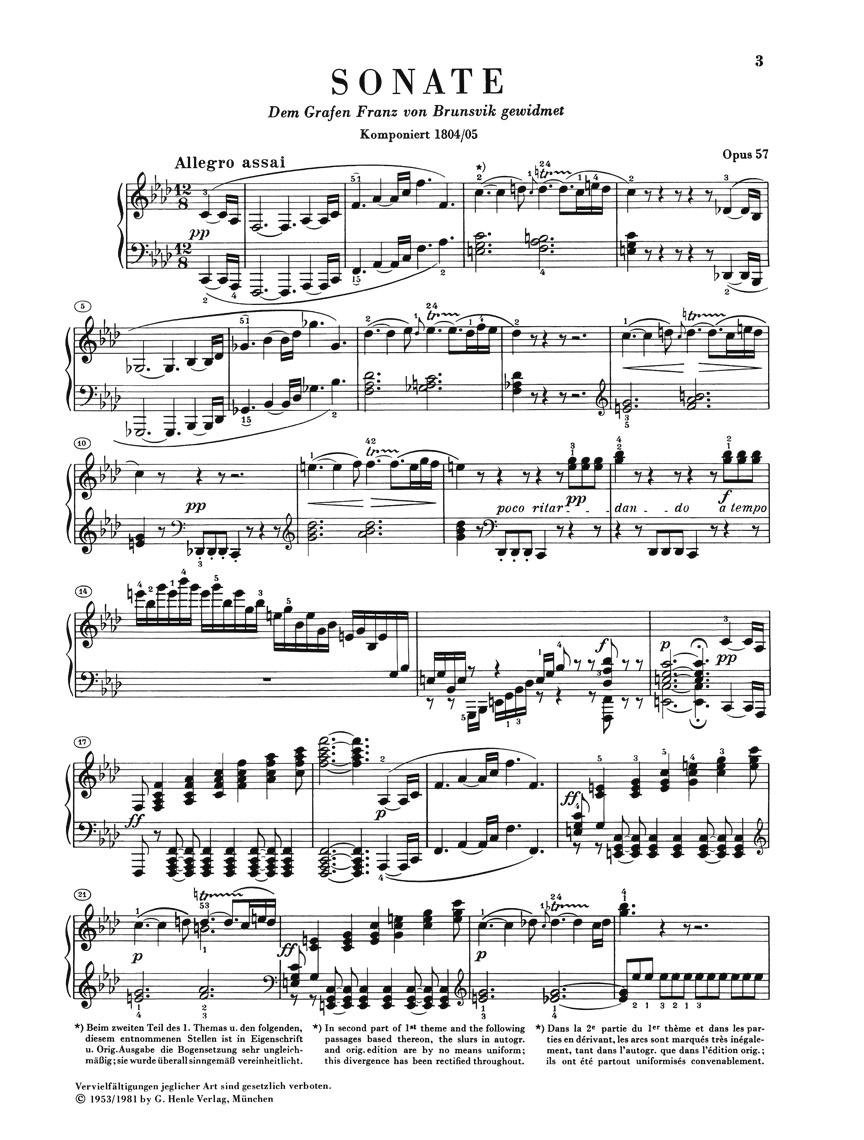
Beethoven Piano Sonata No.23 in f minor Op.57 (Appassionata 열정) for Piano Solo
베토벤 피아노 소나타 23번 f단조 Op.57 「열정」 피아노 독주(솔로)
악기 구성
Piano Solo 피아노 독주(솔로)
Bertha Antonia Wallner (Editor) 베르타 안토니아 발너
Conrad Hansen (Fingering Piano) 콘라트 한젠
Urtext Edition, paperbound
Pages 31 (II+29)
Content
Piano Sonata f minor Op.57 피아노 소나타 f단조 (Appassionata, 열정)
9 difficult
Next to the Moonlight and the Waldstein Sonatas, the Appassionata is no doubt the most celebrated of Beethoven’s piano sonatas and claims, with the latter two works, a new high point in the composer’s piano oeuvre. With even Lenin weighing in with the words: “Such miraculous works can only be made by man,” what is there left to say!
Curiously, the nickname Appassionata appeared for the first time in 1838 in a transcription of the sonata for piano four-hands published by the Cranz Verlag in Hamburg; although this designation did not originate with Beethoven, it is nowadays inseparably connected with the work. It fits splendidly with the dramatic contrasts of the first movement, the solemnity and inwardness of the second and the demonic passion of the third.
「월광」, 「발트슈타인」 소나타와 더불어 「열정」은 의심할 여지 없이 베토벤 피아노 소나타 가운데 가장 유명한 곡이며, 이 두 곡과 함께 작곡가의 피아노 작품에서 새로운 정점을 이룹니다. 레닌조차 “이토록 경이로운 작품은 인간만이 만들 수 있다”는 말을 남겼으니, 더 무슨 말이 필요하겠습니까!
흥미롭게도 「아파시오나타(열정)」라는 별명은 1838년 함부르크의 크란츠 출판사에서 펴낸 피아노 포핸즈 편곡판에서 처음 등장했습니다. 이 명칭은 베토벤이 붙인 것이 아니지만, 오늘날에는 작품과 떼려야 뗄 수 없는 이름이 되었습니다. 이 별명은 1악장의 극적인 대비, 2악장의 장엄함과 내면성, 3악장의 악마적인 열정에 멋지게 어울립니다.
작곡가 Beethoven, Ludwig Van (1770-1827)
에디터 Wallner, Bertha Antonia