
Happy Present Meet
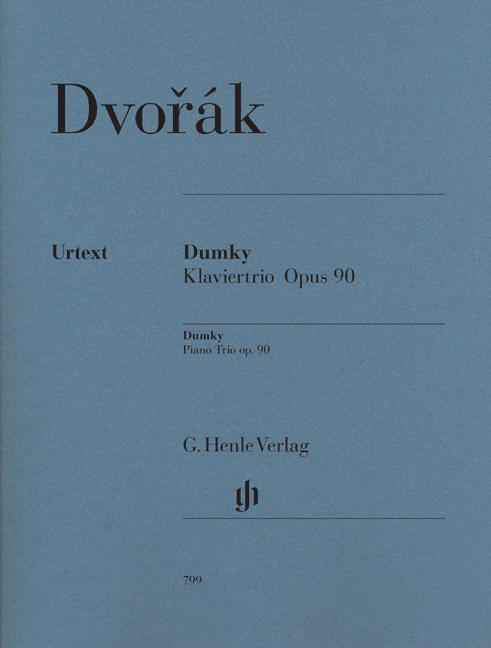
Dvorak Dumky in e minor Op.90 for Piano Trio for Violin, Cello and Piano (Parts)
드보르자크(드보르작) 둠키 · 피아노 삼중주(피아노 트리오) e단조 Op.90 (바이올린, 첼로, 피아노)
악기 구성
Piano Trios 피아노 3중주(트리오)
Violin, Cello and Piano 바이올린, 첼로, 피아노
Klaus Doge (Editor) 클라우스 되게
Andreas Groethuysen (Fingering Piano) 안드레아스 그로에투이젠
Urtext Edition, paperbound
Pages 83 (VIII+52+11+12)
Content
Dumky · Piano Trio Op.90 둠키 · 피아노 삼중주
“At certain points it will be like a serious song, at others like a happy dance …” This was how Dvořák described the work which he was composing at the time to a friend in 1890. The word “Dumka” (plural “Dumky”) actually describes a Slavic dance-form with a noticeable alternation between melancholic and dance-like boisterous passages. The Dumka is a recurring theme in Dvořák’s chamber music; although always only as a single movement. The unusual form of this piano trio – it has a succession of six “Dumky”, each with its own very distinctive character and great expressiveness – means that it is one of the Czech master’s best-loved works.
“어떤 대목은 진지한 노래 같고, 또 어떤 대목은 즐거운 춤 같을 것입니다 …” 1890년 드보르자크는 당시 작곡 중이던 이 작품을 한 친구에게 이렇게 설명했습니다. “둠카(Dumka)”(복수형 “둠키(Dumky)”)라는 말은 본래 우수 어린 부분과 춤곡풍의 떠들썩한 부분이 눈에 띄게 교차하는 슬라브의 춤 형식을 가리킵니다. 둠카는 드보르자크의 실내악에서 되풀이해 등장하는 주제이지만, 언제나 한 악장으로만 쓰였습니다. 이 피아노 트리오의 독특한 형식, 즉 저마다 매우 뚜렷한 개성과 큰 표현력을 지닌 여섯 개의 “둠키”가 이어지는 구성 덕분에 이 곡은 체코 거장의 가장 사랑받는 작품 가운데 하나가 되었습니다.
작곡가 Dvorak, Antonin (1841-1904)
에디터 Doge(Doege), Klaus
Haydn Piano Trios Vol.4 for Violin, Cello and Piano (Parts)
Franck Sonata in A major for Cello and Piano
[통신판매]입금결제(단체주문,퀵착불,인터넷,매장방문입금)
Debussy 12 Etudes Volumes 1 and 2 for Piano Solo
Piazzolla Verano Porteno (사계중 여름) for Violin, Cello and Piano
Piazzolla Primavera Portena (사계중 봄) for Violin, Cello and Piano (arr. Piano Trio)
Piazzolla Otono Porteno (사계중 가을) for Violin, Cello and Piano (arr. Piano Trio)
Piazzolla Tango Ballet for Stirng Quartet (Set of Parts) (VN1,2/VA/VC)
Grieg String Quartet in g minor Op.27 for 2 Violins, Viola and Cello